

Executive Summary
Problem Statement: Your hyper-automated vertical farming infrastructure relies on a delicate balance of nutrient delivery, lighting, and climate control. Currently, these Operational Technology (OT) systems are vulnerable to cyber-sabotage—where minor adjustments to pH or light spectra can result in total crop failure—and industrial espionage targeting your proprietary growth formulas.
Cost of Inaction: A successful breach could lead to the immediate loss of entire harvest cycles (millions in lost revenue), permanent brand damage due to supply chain instability, and the loss of competitive advantage if "growth recipes" are exfiltrated by competitors.
Proposed Solution: We propose a Zero-Trust Cognitive Enterprise (ZTCE) framework. Unlike traditional security that trusts everything inside the farm's network, this approach assumes the network is already compromised. It implements strict identity verification for every sensor and actuator (the "things") and employs an AI-driven Cognitive Layer to monitor environmental telemetry in real-time. If a nutrient pump behaves erratically or a formula is accessed from an unusual location, the system autonomously blocks the action before the crop is impacted.
Expected Outcome: Transformation from a "perimeter-based" security posture to a "data-centric" posture, ensuring that only verified identities can alter growth parameters and that any anomaly in plant telemetry triggers an immediate, automated response.
Customer Engagement Process
The engagement process for deploying a Zero-Trust Cognitive Enterprise (ZTCE) integrated with LLM-enabled knowledge management is a rigorous, five-stage lifecycle designed to eliminate implicit trust while maximizing operational intelligence.
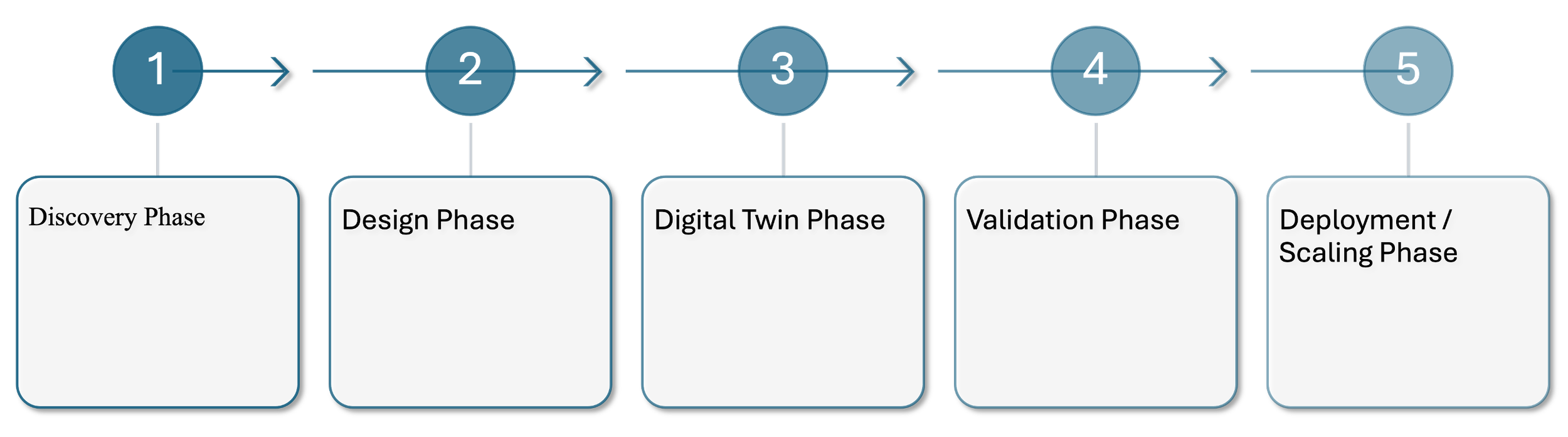
Discovery Phase: We will conduct targeted workshops to map the intersection of agronomy and cybersecurity.
Stakeholder Interviews: We will conduct targeted interviews to map the attack surface:
COO/Head of Production: Identify "Critical Growth Windows" where downtime is unacceptable.
CTO/Automation Lead: Audit existing PLC (Programmable Logic Controller) and IoT protocols (MQTT, CoAP, Modbus).
CISO: Review current network segmentation and incident response playbooks.
Head of Agronomy: Define the "Golden Baseline" for proprietary growth formulas.
Artifacts Collection:
OT Network Topology maps (Sensor $\rightarrow$ Gateway $\rightarrow$ Cloud/On-prem Controller).
Complete Asset Inventory (MAC addresses, firmware versions of all actuators/sensors).
API documentation for the Automation Orchestrator.
Design Phase: We will utilize a Gap Analysis Matrix mapping current capabilities against the CISA Zero Trust Maturity Model (ZTMM):
Traditional: Flat network; password-based access to controllers.
Initial: Basic VLAN segmentation; MFA for human admins.
Advanced: Device-level identities; AI-based anomaly detection in telemetry.
Optimal: Fully automated PDP/PEP (Policy Decision/Enforcement Points) with real-time trust scoring.
Digital Twin Prototyping and System DevelopmentPhase: Leveraging high-performance HAAES DAVIS hardware to create a high-fidelity virtual replica of the customer's environment; this allows for the development and stress-testing of the cognitive engine and LLM performance in a sandboxed ecosystem that mirrors real-world telemetry.
Validation/Pilot (Proof of Value): A 30-day PoV focusing on the Cognitive Component:
Scenario: "The Sabotage Simulation"
Setup: A mirrored environment of one growth rack.
Test: An unauthorized device attempts to inject a command to increase nutrient concentration by 20% (outside the agronomic baseline).
Pass Criteria: The Cognitive Layer must detect the telemetry anomaly and the PDP must revoke the actuator's authorization within $<5$ seconds, preventing the change.
Deployment & Scaling
Observation Mode: Deploy AI sensors to learn "normal" growth patterns without blocking.
Shadow Enforcement: Log "would-be" blocks to tune out false positives (e.g., seasonal adjustments).
Hard Enforcement: Activate the PEPs to block non-compliant traffic in a phased rollout by growth zone.
Architectural Mapping
Logical Layers
Identity Layer: Every sensor, actuator, and admin is assigned a unique Machine Identity (X.509 certificate). No "shared" passwords for PLCs.
Network/Transport Layer: Micro-segmentation using Software-Defined Perimeters (SDP). The "Nutrient Zone" cannot communicate with the "Lighting Zone" unless explicitly permitted.
Data & Application Layer: Encryption of growth formulas at rest and in transit. API Gateways enforce strict schema validation for all telemetry data.
Cognitive/Intelligence Layer: A UEBA (User and Entity Behavior Analytics) engine that analyzes time-series environmental data to detect "silent" sabotage.
Control Plane vs. Data Plane: The Control Plane (PDP) manages the trust scores; the Data Plane (PEP) executes the actual flow of telemetry and commands.
Reference Diagram Specifications
Logical Architecture: A hub-and-spoke model where all IoT traffic must pass through a Policy Enforcement Point (PEP) before reaching the Actuators. The PEP queries the Policy Decision Point (PDP), which integrates AI telemetry.
Transaction Sequence: Sensor $\rightarrow$ Identity Check (Cert) $\rightarrow$ AI Telemetry Analysis (Baseline Check) $\rightarrow$ PDP Decision $\rightarrow$ PEP Allow/Deny $\rightarrow$ Actuator.
Zone Map: Division of the facility into "Cellular Zones" (e.g., Zone A: Leafy Greens, Zone B: Strawberries), each with its own micro-perimeter.
Representative Technology Stack
| Layer | Category | Example Tools/Vendors |
|---|---|---|
| Identity | PKI / Machine Identity | HashiCorp Vault, Venafi, AWS IoT Core |
| Network | SASE / Micro-segmentation | Akamai Guardicore, Zscaler, Cisco TrustSec |
| Cognitive | AI/UEBA for OT | Darktrace OT, Nozomi Networks, Claroty |
| Control Plane | PDP / Policy Engine | OPA (Open Policy Agent), Google BeyondCorp |
| Data Layer | API Gateway / Encryption | Kong, Apigee, HashiCorp Boundary |
Governance & Compliance Framework
Regulatory Alignment
Given the proprietary nature of growth formulas and food security implications:
NIST SP 800-207: The core blueprint for Zero Trust implementation.
IEC 62443: The international standard for Industrial Automation and Control Systems (IACS) security.
CMMC 2.0 Level 2 (Optional): If the facility supports government food security contracts, we will map controls to "Controlled Unclassified Information" (CUI) protections for proprietary formulas.
Policy Engine Logic: The Trust Algorithm
Access is not binary; it is a calculated score (S).
S = (I_{conf} * w(1)) + (D_{post} * w(2)) + (T_{telemetry} * w(3)) + (B_{risk} * w(4))
Variables:
I_{conf} (Identity Confidence): Valid X.509 cert? → High.
D_{post} (Device Posture): Firmware up to date? No known CVEs? →Medium/High.
T_{telemetry} (Telemetry Alignment): Is the requested change within $2\sigma$ of the agronomic baseline? → High.
$B_{risk}$ (Behavioral Risk): Has this device attempted to scan other ports? $\rightarrow$ Low/Negative.
Adaptive Triggers: If S < Threshold, trigger Step-up Authentication (requires manual Agronomist approval via mobile app) or Immediate Quarantine.
Success Metrics and KPIs
| Metric | Baseline (Current) | Target (Post-ZTA) |
|---|---|---|
| MTTD (Mean Time to Detect) | Days/Weeks (via crop failure) | < 15 Minutes (via AI anomaly) |
| Attack Surface Reduction | Flat network; all ports open | > 90% reduction in lateral paths |
| IoT Identity Coverage | 0% (Shared passwords) | 100% (Unique certificates) |
| User Friction Index | Low (No security) | < 2 additional prompts/day for admins |
| Compliance Score | Non-compliant (IEC 62443) | ≥ 85% alignment with Level 2 |
Implementation Roadmap
Horizon 1: Visibility & Hardening (0-3 Months)
Focus: Asset discovery and identity foundation.
Actions: Deploy passive OT monitoring; implement MFA for all human access to the automation orchestrator; establish PKI for critical actuators.
RACI: Vendor (Lead Design), Client IT (Implementation).
Horizon 2: Cognitive Integration (3-12 Months)
Focus: Intelligence and Micro-segmentation.
Actions: Deploy AI UEBA to baseline environmental telemetry; implement micro-segmentation between growth zones; integrate PDP/PEP for high-risk actuators.
RACI: Vendor (AI Tuning), Client Ops (Validation).
Horizon 3: Autonomous Zero Trust (12+ Months)
Focus: Full maturity and self-healing.
Actions: Shift to fully dynamic trust scoring; automate quarantine of anomalous sensors; implement "Immutable Growth Recipes" via encrypted vaults.
RACI: Client Security Team (Ownership), Vendor (Optimization).
Rough Order of Magnitude (ROM) Investment Model
| Horizon | Cost Band | Primary Drivers |
|---|---|---|
| Horizon 1 | Medium | PKI Licensing, Professional Services for OT Audit. |
| Horizon 2 | High | AI/UEBA Licenses, SASE Gateway Hardware, Integration Labor. |
| Horizon 3 | Low/Medium | Ongoing SaaS subscriptions, Managed Security Service (MSSP). |
Risks, Assumptions & Dependencies
Risk: Legacy Hardware Incompatibility. Some older sensors may not support X.509 certificates.
Mitigation: Use "ZTA Proxies" (Hardware wrappers) to provide identity for legacy devices.
Risk: Latency in Control Loops. AI analysis might delay critical actuator commands.
Mitigation: Implement "Fast-Path" policies for safety-critical functions, with asynchronous AI auditing.
Assumption: The client provides a complete and accurate inventory of all IoT devices.
Dependency: Availability of the Head Agronomist to define the telemetry baselines.
Appendix
Glossary
ZTA: Zero Trust Architecture.
PDP/PEP: Policy Decision Point / Policy Enforcement Point.
UEBA: User and Entity Behavior Analytics.
OT: Operational Technology (Hardware/Software that detects or causes a change through the direct monitoring and/or control of physical devices).
Reference Citations
NIST SP 800-207: Zero Trust Architecture standards.
CISA ZTMM 2.0: Zero Trust Maturity Model pillars (Identity, Device, Network, Application, Data).
IEC 62443: Security for Industrial Automation and Control Systems.