

Executive Summary
Problem Statement: The organization's high-value asset tracking systems currently rely on implicit trust of telemetry data. This creates a critical vulnerability where adversaries can spoof location data or disable security alarms, leading to the physical theft of critical assets and total loss of visibility without triggering alerts.
Cost of Inaction: A single successful breach could result in millions of dollars in lost hardware, severe contractual penalties for failing to protect sensitive government/corporate property, and a potential loss of "Authorized" status under CMMC 2.0 compliance, jeopardizing future revenue streams.
Proposed Solution: We propose the implementation of a Zero-Trust Cognitive Enterprise (ZTCE) framework. This shifts security from a perimeter-based model to a per-asset identity model. By assigning unique, cryptographically verifiable identities to every sensor and telemetry stream—and layering an AI-driven "Cognitive Engine" to detect behavioral anomalies in movement and system inputs—we ensure that only authenticated data is trusted and any spoofing attempt is detected in real-time.
Expected Outcome: Total elimination of implicit trust in the telemetry pipeline, a drastic reduction in the window of detection for asset theft (MTTD), and full alignment with NIST SP 800-207 and CMMC 2.0 standards.
Customer Engagement Process
The engagement process for deploying a Zero-Trust Cognitive Enterprise (ZTCE) integrated with LLM-enabled knowledge management is a rigorous, five-stage lifecycle designed to eliminate implicit trust while maximizing operational intelligence.
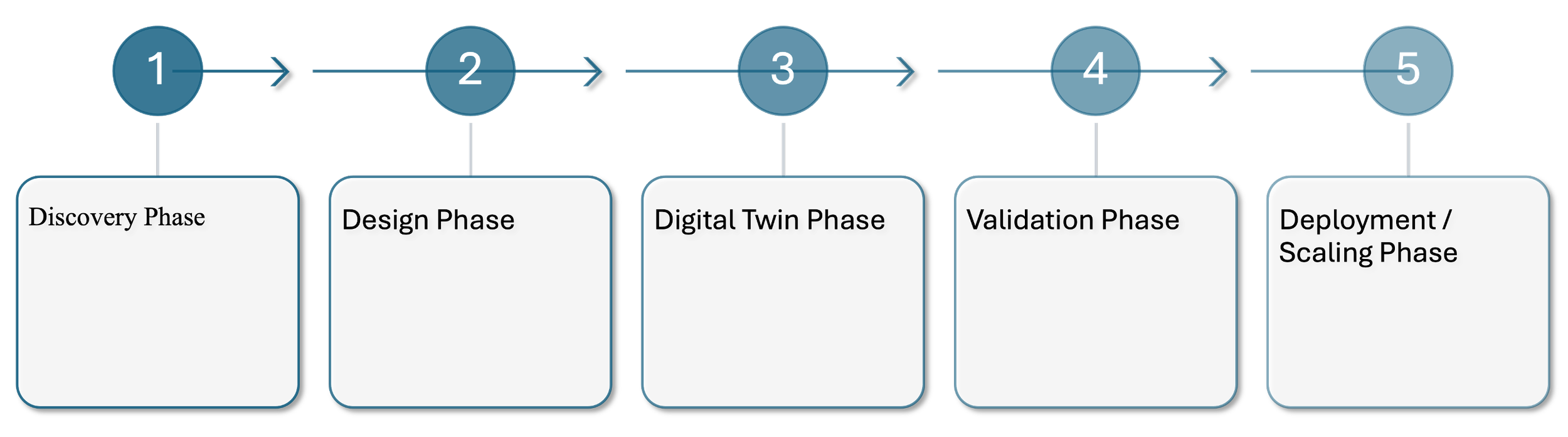
Discovery Phase: We will conduct targeted interviews to map the attack surface:
CISO: Define risk appetite for "false positives" in AI alerts vs. the cost of a missed theft event.
CTO/Lead Architect: Review current sensor hardware capabilities (e.g., support for mTLS, TPMs) and telemetry protocols (MQTT, CoAP, HTTPS).
Ops Manager: Document typical asset movement patterns ("Golden Path") to baseline AI behavior.
Compliance Officer: Identify specific CMMC 2.0 Level 2 controls currently failing or at risk.
Program Manager: Determine the criticality and valuation of assets being tracked.
Artifacts Collection: Current network topology, asset inventory (hardware versions), existing IAM configurations for monitoring dashboards, and recent audit findings regarding physical security.
Design Phase: We will utilize a Gap Analysis Mapping against the CISA Zero Trust Maturity Model:
Traditional → Initial: Moving from shared API keys to unique device identities.
Initial →Advanced: Implementing dynamic policy enforcement based on real-time telemetry.
Advanced → Optimal: Fully autonomous response (e.g., AI triggers a lockdown of an asset if spoofing is detected).
Digital Twin Prototyping and System DevelopmentPhase: Leveraging high-performance HAAES DAVIS hardware to create a high-fidelity virtual replica of the customer's environment; this allows for the development and stress-testing of the cognitive engine and LLM performance in a sandboxed ecosystem that mirrors real-world telemetry.
Validation/Pilot (Proof of Value): A 30-day PoV focusing on the Cognitive Component:
Scenario: A "Red Team" attempt to inject spoofed GPS coordinates into the telemetry stream using a rogue device.
Pass Criteria: The AI engine must detect the anomaly (via geo-velocity or signal inconsistency) and the Policy Decision Point (PDP) must revoke the device's access token within $< 60$ seconds.
Deployment & Scaling
Shadow Mode: Deploy AI monitoring alongside existing systems; alerts are logged but no blocking occurs.
Pilot Group: Apply hard enforcement to a small subset of the highest-value assets.
Phased Rollout: Expand across all asset classes in waves, ensuring zero downtime for critical visibility.
Repesentative Technology Stack
| Layer | Category | Example Tooling |
|---|---|---|
| Identity | IdP / PKI | HashiCorp Vault, Azure IoT Hub Device Provisioning Service (DPS) |
| Transport | SASE / SDP | Cloudflare Zero Trust or Zscaler Private Access (ZPA) |
| Ingest/PEP | API Gateway | Kong Mesh or Apigee |
| Intelligence | UEBA / AI | Splunk Enterprise Security with MLTK or Datadog Watchdog |
| Monitoring | SIEM / SOAR | Palo Alto Cortex XSOAR or Microsoft Sentinel |
Governance & Compliance Framework
Regulatory Alignment: This design is mapped specifically to the Defense Industrial Base (DIB) requirements:
CMMC 2.0 Level 2: Focuses on protecting Controlled Unclassified Information (CUI). Asset locations of critical defense components are treated as CUI.
NIST SP 800-171: Ensuring the confidentiality and integrity of telemetry data via encryption at rest and in transit.
NIST SP 800-207: Adherence to the core ZTA tenet: "All communication is secured regardless of network location."
Policy Engine Logic (The Trust Algorithm): Access decisions for telemetry ingestion are calculated as follows:
Trust Score = (W_1 Cert Validity) + (W_2 Device Posture) + (W_3 * Behavioral Consistency)
Variables:
Identity Confidence: Is the X.509 certificate valid and not revoked? (Binary)
Device Posture: Does the sensor heartbeat match expected firmware versions? (Weighted)
Behavioral Risk Score: Does the current GPS coordinate align with previous coordinates given the time elapsed (Geo-velocity check)? (Weighted)
Adaptive Triggers: If Trust Score < Threshold, the system triggers Step-up Authentication (e.g., requiring a manual admin override or secondary sensor verification) and flags the asset as "Compromised.”
Success Metrics & KPIs
| Metric | Baseline (Current) | Target (Post-ZTA) |
|---|---|---|
| MTTD (Spoofing Attack) | Days/Weeks (or never) | < 5 Minutes |
| MTTR (Incident Response) | Manual investigation | Automated isolation via SOAR |
| Attack Surface | Open ports for telemetry | 0 open inbound ports (Outbound only) |
| Asset Visibility Gap | High risk of "blind spots" | 100% cryptographically verified streams |
| User Friction Index | Low (Implicit trust) | Medium (Initial setup → Low during Ops) |
Implementation Roadmap
Horizon 1: Foundation (0-3 Months)
Quick Wins: Inventory all sensors; deploy MFA for all monitoring dashboard users.
Hardening: Implement basic encryption on telemetry streams.
RACI: Client (Asset List), Vendor (Architecture Design).
Horizon 2: Cognitive Integration (3-12 Months)
Identity Migration: Transition from API keys to unique X.509 certificates per device.
AI Training: Deploy the UEBA engine in "Learning Mode" to baseline asset movement patterns.
RACI: Client (Ops support), Vendor (AI Model Tuning, PKI Deployment).
Horizon 3: Zero-Trust Maturity (12+ Months)
Full Enforcement: Enable the PDP to automatically block telemetry from low-trust devices.
Autonomous Response: Integrate SOAR to trigger physical security alarms when AI detects spoofing.
RACI: Client (Security Ops), Vendor (Optimization & Handover).
Rough Order of Magnitude (ROM) Investment Model
| Horizon | Licensing Cost | Professional Services | Estimated Staffing/FTE | Total Band |
|---|---|---|---|---|
| Horizon 1 | Low (Existing tools) | Medium (Design) | 0.5 FTE (Client) | Low-Medium |
| Horizon 2 | Medium (AI/PKI) | High (Implementation) | 1.0 FTE (Client) | Medium-High |
| Horizon 3 | Medium (SaaS Ops) | Low (Optimization) | 0.5 FTE (Client) | Low-Medium |
- SIEM Ingestion: Volume of telemetry packets analyzed by AI.
- PKI Management: Cost per certificate/device for high-volume asset tags.
- Hardware Upgrades: Potential need to replace legacy sensors that cannot support mTLS.
Risks, Assumptions & Dependencies
Assumption: All critical assets are equipped with sensors capable of supporting modern cryptographic standards (e.g., ECC/RSA).
Dependency: Availability of a reliable time-sync mechanism (NTP) across all sensors to prevent certificate expiration errors.
Risk 1: AI Noise. High false-positive rates in anomaly detection could lead to "alert fatigue." Mitigation: Extended learning phase and human-in-the-loop validation.
Risk 2: Latency. mTLS handshakes and AI analysis may introduce latency in real-time tracking. Mitigation: Edge computing/PEP placement at the gateway level.
Risk 3: Hardware Constraints. Some low-power sensors may struggle with encryption overhead. Mitigation: Use of lightweight cryptography (e.g., ChaCha20) where applicable.
Appendix
Glossary
ZTA: Zero Trust Architecture.
PDP/PEP: Policy Decision Point / Policy Enforcement Point.
UEBA: User and Entity Behavior Analytics.
SOAR: Security Orchestration, Automation, and Response.
mTLS: Mutual Transport Layer Security (both client and server authenticate).
Reference Citations
NIST SP 800-207: Zero Trust Architecture.
CISA ZTMM 2.0: Zero Trust Maturity Model.
CMMC 2.0: Cybersecurity Maturity Model Certification.