

Executive Summary
Problem Statement: Deep sea mining operations rely on a fragile chain of telemetry between autonomous underwater vehicles (AUVs), remotely operated vehicles (ROVs), and surface support vessels. Current trust models are often implicit, meaning once a device is "on the network," its data is trusted. This creates a critical vulnerability: an adversary can hijack robotic assets or inject spoofed geological data, leading to the loss of multi-million dollar equipment or the redirection of extraction efforts toward worthless areas, resulting in massive capital waste and operational failure.
Cost of Inaction: A single successful "data spoofing" attack could result in months of wasted exploration expenditure (OPEX) and the potential permanent loss of autonomous assets. Furthermore, if these operations are tied to strategic mineral contracts, a breach could lead to contract termination or national security concerns regarding critical mineral supply chains.
Proposed Solution: We propose a Zero-Trust Cognitive Enterprise (ZTCE) framework. This shifts security from "perimeter defense" to "continuous verification." By treating every telemetry stream as potentially hostile and utilizing AI to baseline "normal" robotic behavior and geological signatures, the system can automatically isolate compromised assets and reject spoofed data in real-time.
Expected Outcome: Total visibility into the provenance of all underwater data, a drastic reduction in the risk of asset hijacking, and an automated "immune system" capable of detecting sophisticated anomalies that traditional rule-based security would miss.
Engagement Process
The engagement process for deploying a Zero-Trust Cognitive Enterprise (ZTCE) integrated with LLM-enabled knowledge management is a rigorous, five-stage lifecycle designed to eliminate implicit trust while maximizing operational intelligence.

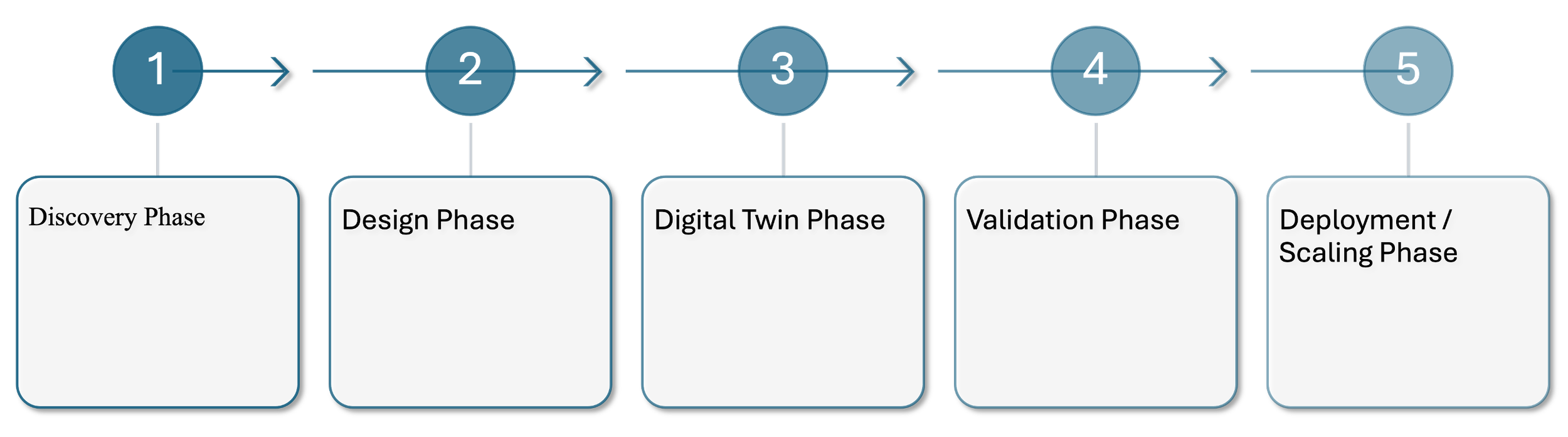
Discovery Phase
The objective is to map the "Telemetry Value Chain."
Stakeholder Interviews:
CISO/Security Lead: Current risk appetite, existing encryption standards for satellite links, and incident response capabilities.
CTO/Chief Engineer: AUV/ROV communication protocols (Acoustic, Optical, Satellite), latency tolerances, and firmware update mechanisms.
Ops Manager (Marine): Operational workflows—how are missions planned and how is "situational awareness" currently visualized?
Compliance Officer: Requirements for strategic mineral reporting and environmental regulatory mandates.
Artifacts to Collect:
Network topology of the Surface Support Vessel (SSV).
API specifications for AUV-to-Surface telemetry.
Inventory of all underwater assets and their unique hardware identifiers.
Baseline geological data sets (to train the AI anomaly detector).
Design Phase
We will employ a Gap Analysis against CISA ZTMM 2.0, moving from "Traditional" (implicit trust in the vessel's local network) to "Optimal" (dynamic, risk-based access for every telemetry packet).
Mapping: Current State $\rightarrow$ Identity-centric state → Cognitive/Adaptive state.
Digital Twin Prototyping and System Development Phase
Leveraging high-performance HAAES DAVIS hardware to create a high-fidelity virtual replica of the customer's environment; this allows for the development and stress-testing of the cognitive engine and LLM performance in a sandboxed ecosystem that mirrors real-world telemetry.
Validation/Pilot (Proof of Value)
A controlled environment test involving one AUV and the SSV:
Scenario: "The Ghost Signal." An unauthorized device attempts to inject spoofed mineral survey data into the telemetry stream.
Pass Criteria:
PDP rejects the packet due to lack of valid cryptographic identity (Identity Pillar).
AI engine flags the geological data as "statistically improbable" based on historical seabed baselines (Cognitive Layer).
Deployment & Scaling
Shadow Mode: Deploy AI anomaly detection in "Alert Only" mode to baseline robotic behavior without interrupting missions.
Phased Enforcement: Implement strict identity verification for command-and-control (C2) links first, then telemetry streams.
Full ZT Maturity: Transition to autonomous isolation of assets exhibiting anomalous behavioral patterns.
Architectural Mapping
Logical Layers
Identity Layer: Machine-to-Machine (M2M) identities for every AUV/ROV using hardware-backed certificates (TPM/Secure Element).
Network/Transport Layer: Software-Defined Perimeter (SDP) creating "Black Clouds"—the SSV and Shore Command are invisible to the public internet; AUVs communicate via encrypted, authenticated tunnels.
Data & Application Layer: Micro-segmentation of telemetry streams. Geological data is isolated from C2 traffic.
Cognitive/Intelligence Layer: The "Brain" that analyzes telemetry for behavioral and data anomalies.
Control Plane (PDP): Located on the SSV and Shore Command; decides if a packet is trusted based on identity + context.
Data Plane (PEP): Embedded in AUV firmware and SSV gateways; enforces the PDP's decision.
Reference Diagram Specifications
Logical Architecture: Show the PDP (Policy Decision Point) at the Shore Command/SSV and the PEP (Policy Enforcement Point) at the AUV ingress/egress points.
Sequence Diagram: AUV → Request Access with Cert + Telemetry → PEP → PDP (checks Identity, Device Health, Behavioral Score) → Allow/Deny.
Zone Map: Define three zones: Submerged Zone (Untrusted), Vessel Zone (Transit/Inspection), and Shore Zone (Management).
Representative Technology Stack
| Layer | Category | Example Tools/Vendors |
|---|---|---|
| Identity | M2M IdP / PKI | HashiCorp Vault, AWS IoT Core (Device Defender) |
| Network | SASE / SDP | Zscaler, Appgate, Cloudflare One |
| Cognitive | UEBA / AI Anomaly | Datadog (Watchdog), Splunk DSP, Custom PyTorch Models |
| Control Plane | Policy Engine | OPA (Open Policy Agent) |
| Endpoint | Hardware Root of Trust | TPM 2.0, Nitro Enclaves |
Governance & Compliance Framework
Regulatory Alignment
Given the strategic nature of deep-sea mining:
NIST SP 800-207: The foundational blueprint for the ZTA implementation.
CMMC 2.0 Level 2 (Advanced): Applied to ensure that "Controlled Unclassified Information" (CUI)—such as precise mineral coordinates—is protected against state-sponsored espionage.
ISO/IEC 27001: For general information security management of the shore-based operations center.
Policy Engine Logic (The Trust Algorithm)
Access is not binary but a calculated score:
Trust Score = (W_1 * IdConf) + (W_2 DevPost) + (W_3 * BehavRisk) + (W_4 * DataIntegrity)
Identity Confidence (IdConf): Valid cert, non-expired, signed by trusted CA.
Device Posture (DevPost): Firmware version current, no unauthorized process trees detected on AUV.
Behavioral Risk (BehavRisk): AI analysis of movement (e.g., is the AUV moving in a pattern inconsistent with its mission profile?).
Data Integrity (DataIntegrity): Does the geological data align with known seabed physics?
Triggers:
Score < 60 → Immediate Block & Alert.
Score 60-80→ Step-up Authentication (Challenge/Response).
Score > 80 → Allow Access.
Success Metrics and KPIs
| Metric | Baseline (Traditional) | Target (Zero Trust Cognitive) |
|---|---|---|
| MTTD (Spoofing) | Days/Weeks (until manual audit) | < 5 Minutes (AI detection) |
| MTTR (Hijack) | Hours (manual recovery) | Seconds (Automated Isolation) |
| Attack Surface | All open ports on SSV network | Zero visible ports (SDP "Dark" Network) |
| Data Integrity Score | Manual verification of survey data | 99.9% AI-validated telemetry streams |
| User Friction Index | Low (Implicit trust) | Medium (Initial setup), Low (Transparent ZTA) |
Implementation Roadmap
Horizon 1: Foundation (0-3 Months)
Quick Wins: Deploy SDP between Shore Command and SSV; implement MFA for all human operators.
Critical Vuln Remediation: Hardening of AUV firmware update channels.
RACI: Vendor (Lead Architect), Client (IT Ops).
Horizon 2: Cognitive Integration (3-12 Months)
Identity Migration: Roll out M2M certificates to all AUV/ROV fleets.
AI Deployment: Deploy anomaly detection models for robotic behavior and geological data streams in "Shadow Mode."
RACI: Vendor (AI/Security Engineer), Client (Robotics Team).
Horizon 3: Full ZT Maturity (12+ Months)
Autonomous Response: Enable the PDP to automatically trigger "Safe Mode" on AUVs upon detection of high-risk behavioral anomalies.
Continuous Monitoring: Integration of all telemetry into a unified SOAR platform for autonomous triage.
RACI: Client (Security Ops), Vendor (Maintenance/Optimization).
Rough Order of Magnitude (ROM) Investment Model
| Horizon | Cost Band | Primary Drivers | Staffing Estimate |
|---|---|---|---|
| Horizon 1 | Low-Medium | SASE Licensing, Professional Services (Design) | 2 FTE (Vendor), 1 FTE (Client) |
| Horizon 2 | Medium-High | AI Model Training, PKI Infrastructure, Hardware TPMs | 3 FTE (Vendor), 2 FTE (Client) |
| Horizon 3 | Medium | SOAR Licensing, Continuous Optimization | 1 FTE (Vendor), 2 FTE (Client) |
Risks, Assumptions & Dependencies
Assumption: AUVs have sufficient compute power to handle local PEP functions and cryptographic signing without depleting battery life prematurely.
Dependency: Availability of clean historical geological data for AI training.
Top Risks:
Acoustic Latency: ZTA handshakes may introduce latency in low-bandwidth underwater links. Mitigation: Use session-based tokens with longer TTLs for submerged assets.
False Positives: AI flags a legitimate geological discovery as "spoofed data." Mitigation: Implement a human-in-the-loop override for high-value data anomalies.
Hardware Failure: TPM failure on an AUV renders it "untrusted" and unreachable. Mitigation: Secure physical recovery protocols and "break-glass" emergency keys.
Appendix
Glossary
ZTA: Zero Trust Architecture.
PDP/PEP: Policy Decision Point / Policy Enforcement Point.
UEBA: User and Entity Behavior Analytics (applied here to Robots).
SOAR: Security Orchestration, Automation, and Response.
SDP: Software-Defined Perimeter.
Reference Citations
NIST SP 800-207: Zero Trust Architecture.
CISA ZTMM 2.0: Zero Trust Maturity Model.
CMMC 2.0: Cybersecurity Maturity Model Certification.