

Executive Summary
Problem Statement: Current air defense command-and-control (C2) infrastructures often rely on "perimeter-based" security. Once an attacker breaches the outer network or compromises a single tactical node, they can inject deceptive data or delay critical commands. In an air defense context, this leads to "blind spots," delayed reaction times, or the accidental targeting of friendly assets—effectively neutralizing the airspace defense.
Cost of Inaction: The risk is not measured in financial loss, but in catastrophic operational failure. A successful deception attack on C2 links can result in total loss of airspace integrity, destruction of high-value strategic assets, and loss of life. Furthermore, failure to meet evolving DoD/CMMC cybersecurity mandates risks the decertification of critical defense systems.
Proposed Solution: We propose a Zero-Trust Cognitive Enterprise (ZTCE) framework. This shifts security from "trust but verify" to "never trust, always verify." By implementing micro-segmentation at the node level and an AI-driven "Cognitive Layer," the system treats every command—even those coming from a known commander's terminal—as potentially malicious until verified by real-time telemetry (identity, device health, and behavioral patterns).
Expected Outcome: A resilient, self-healing C2 environment where lateral movement is impossible, spoofed commands are detected in milliseconds via AI anomaly detection, and the attack surface is reduced to the smallest possible functional unit.
Customer Engagement Process
The engagement process for deploying a Zero-Trust Cognitive Enterprise (ZTCE) integrated with LLM-enabled knowledge management is a rigorous, five-stage lifecycle designed to eliminate implicit trust while maximizing operational intelligence.
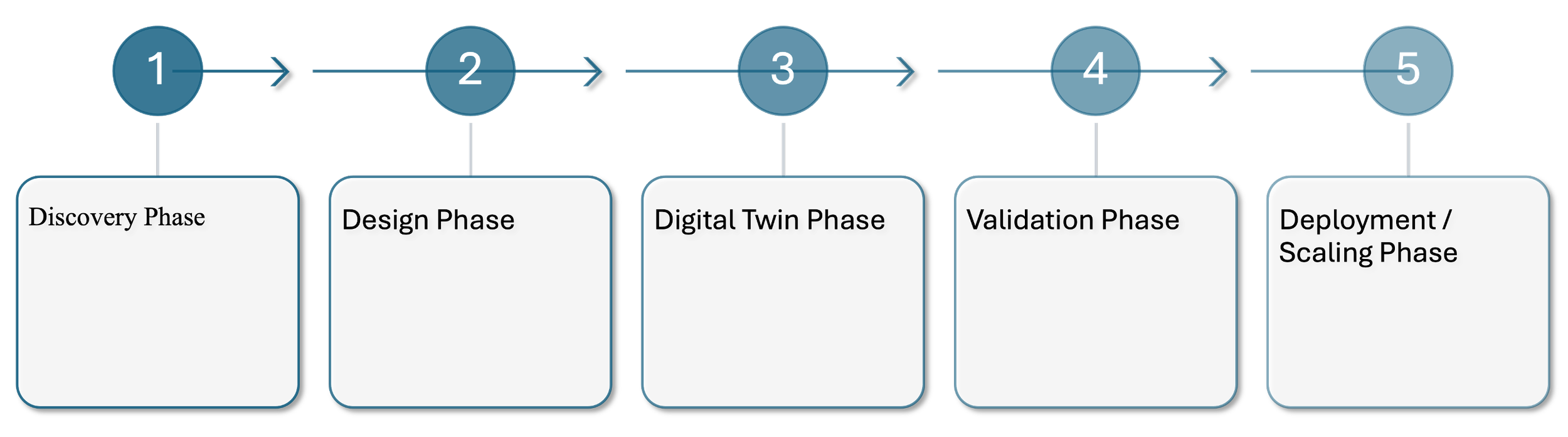
Discovery Phase
The focus is on mapping the "Sensor-to-Shooter" data flow.
Stakeholder Interviews:
CISO/Chief Security Officer: Focus on risk appetite, current breach history, and compliance gaps (CMMC 2.0).
CTO/Lead Architect: Technical constraints of legacy C2 protocols (e.g., Link 16) and hardware limitations at the edge.
Tactical Ops Commander: Requirements for latency; defining "acceptable friction" during high-intensity engagements.
Compliance Officer: Specific NIST SP 800-171/CMMC Level 3 control requirements for tactical data.
Program Manager: Budget cycles and deployment windows for field upgrades.
Artifacts to Collect: Current L2/L3 network topologies, API specifications for C2 interfaces, Hardware Root of Trust (RoT) inventory, and existing IAM role mappings.
Design Phase
We employ a Maturity Gap Analysis based on the CISA ZTMM:
Traditional: Static passwords, flat networks $\rightarrow$ Initial: MFA implemented, basic segmentation $\rightarrow$ Advanced: Dynamic policy enforcement, automated telemetry $\rightarrow$ Optimal: Fully autonomous cognitive response and continuous adaptive trust.
Validation/Pilot (Proof of Value)
Scenario: "The Deceptive Command Injection."
Test: An attacker uses a compromised but "authorized" terminal to send a command to move a missile battery to an incorrect coordinate.
Pass Criteria: The Cognitive Layer must detect the anomaly (e.g., unusual timing of the request, deviation from standard operational patterns) and trigger a Step-up Authentication or block the command entirely, despite the credentials being valid.
Deployment & Scaling
Observation Mode: Deploy PDPs/PEPs in "Log Only" mode to baseline normal C2 traffic.
Shadow Enforcement: AI suggests blocks; human operators confirm.
Hard Enforcement: Full Zero-Trust policy application with automated blocking of non-compliant requests.
Architectural Mapping
Logical Layers
Identity Layer: Machine-to-Machine (M2M) identities using SPIFFE/SPIRE for short-lived, cryptographically verifiable identities for every sensor and effector.
Network/Transport Layer: Software-Defined Perimeter (SDP). All C2 links are encrypted via mTLS; nodes are invisible to the network until authenticated.
Data & Application Layer: Micro-segmentation of tactical applications. The "Radar Processing" app cannot communicate with the "Launcher Control" app without an explicit, time-bound policy grant.
Cognitive/Intelligence Layer: The "Brain." Analyzes telemetry from all layers to calculate a real-time Trust Score.
Control Plane vs. Data Plane: Complete separation. The Policy Decision Point (PDP) resides in the Control Plane; the Policy Enforcement Point (PEP) sits directly in front of each tactical node.
Reference Diagram Specifications
Logical Architecture: A hub-and-spoke model where every node (Radar, C2 Center, Battery) is wrapped in a PEP. All requests must route through the PDP for authorization before reaching the target node.
Auth+Authz Sequence: Request $\rightarrow$ PEP Intercept $\rightarrow$ PDP Query $\rightarrow$ Cognitive Layer (Trust Score Check)$\rightarrow$ Decision (Allow/Deny/Challenge) $\rightarrow$ PEP Execution.
Zone Map: Division of the environment into "Tactical Edge Zones" (Sensors), "Command Zones" (C2 Centers), and "Management Zones" (Admin).
Representative Technology Stack
| Layer | Category | Example Tooling/Vendor |
|---|---|---|
| Identity | IdP / Workload Identity | Okta (Human), SPIFFE/SPIRE (Machine) |
| Device | Hardware Root of Trust | TPM 2.0, HSMs (Hardware Security Modules) |
| Network | SASE / SDP | Zscaler Private Access or Appgate SDP |
| Intelligence | UEBA / AI Engine | Darktrace or Splunk UEBA |
| Enforcement | API Gateway / Micro-segmentation | Istio Service Mesh (for containerized C2) / Illumio |
Governance & Compliance Framework
Regulatory Alignment
CMMC 2.0 Level 3: Focus on protecting Controlled Unclassified Information (CUI) and high-value tactical data via strict access controls.
NIST SP 800-207: Implementation of the core ZTA tenets (all communication is secured regardless of location).
NIST SP 800-171: Ensuring the confidentiality of C2 link configurations and operator credentials.
Policy Engine Logic: The Trust Algorithm
The PDP calculates a Dynamic Trust Score ($TS$). Access is granted only if $TS \ge Threshold$.
TS = (W_1 IdConf) + (W_2 DevPost) + (W_3 GeoLoc) + (W_4 * BehavRisk)
Identity Confidence (IdConf): Strength of MFA/Certificate.
Device Posture (DevPost): TPM attestation, OS patch level, absence of unauthorized processes.
Geo-Location (GeoLoc): Is the request coming from a known tactical coordinate? (GPS validation).
Behavioral Risk (BehavRisk): AI analysis of command frequency and sequence.
Adaptive Triggers: If TS drops by >20% during a session, the system triggers an immediate Step-up Authentication (e.g., biometric re-verification) or terminates the session.
Success Metrics & KPIs
| Metric | Baseline (Current State) | Target (Future State) |
|---|---|---|
| MTTD (Mean Time to Detect) | Hours/Days (Post-incident) | < 5 Seconds (Real-time AI detection) |
| Attack Surface | Flat Network / Open C2 Ports | ≈ 0 visible ports (SDP "Black Cloud") |
| Lateral Movement Risk | High (Single breach = Full access) | Negligible (Micro-segmentation enforced) |
| User Friction Index | Frequent manual logins | Seamless mTLS + Low-friction Biometrics |
| Compliance Score | Partial CMMC Alignment | 100% NIST SP 800-207/CMMC L3 Compliance |
Implementation Roadmap
Horizon 1: Foundation (0–3 Months)
Focus: Identity & Visibility.
Actions: Deploy TPM-based identities; implement MFA for all operators; map all C2 data flows.
RACI: Vendor (Lead Design), Client (Infrastructure Access, Asset Inventory).
Horizon 2: Cognitive Integration (3–12 Months)
Focus: Intelligence & Micro-segmentation.
Actions: Deploy PEPs at node edges; integrate UEBA engine to analyze C2 telemetry; implement the Trust Algorithm in "Observation Mode."
RACI: Vendor (AI Tuning, PDP Config), Client (Ops Testing, Policy Definition).
Horizon 3: Autonomous ZTA (12+ Months)
Focus: Full Maturity & Orchestration.
Actions: Shift to Hard Enforcement; implement autonomous response (e.g., AI automatically isolating a compromised radar node without human intervention).
RACI: Client (Ongoing Ops), Vendor (Optimization/Maintenance).
Rough Order of Magnitude (ROM) Investment Model
| Horizon | Cost Band | Primary Drivers |
|---|---|---|
| Horizon 1 | Medium | Hardware TPM upgrades, IdP licensing, Professional Services for mapping. |
| Horizon 2 | High | AI/UEBA software licenses, PDP/PEP deployment, Integration engineering. |
| Horizon 3 | Low-Medium | Managed services for AI model tuning, continuous compliance auditing. |
Risks, Assumptions & Dependencies
Risk: Latency Overhead. The process of querying a PDP can introduce milliseconds of delay.
Mitigation: Use "Edge-PDPs" to cache authorization decisions locally at the tactical site.
Risk: Legacy Protocol Incompatibility. Some older air defense hardware may not support mTLS or modern APIs.
Mitigation: Deploy "ZTA Proxies" (sidecars) that wrap legacy traffic in secure tunnels.
Assumption: The client provides full access to the C2 signal specifications and allows for a pilot in a simulated environment before live deployment.
Dependency: Availability of Hardware Root of Trust (TPM 2.0) on existing tactical hardware.
Appendix
Glossary
ZTA: Zero-Trust Architecture.
PDP/PEP: Policy Decision Point / Policy Enforcement Point.
UEBA: User and Entity Behavior Analytics.
C2: Command and Control.
mTLS: Mutual Transport Layer Security (Both parties verify certificates).
SPIFFE: Secure Production Identity Framework for Everyone.
Reference Citations
NIST SP 800-207: Zero Trust Architecture.
CISA ZTMM 2.0: Zero Trust Maturity Model.
CMMC 2.0: Cybersecurity Maturity Model Certification.