

Executive Summary
Problem Statement: Autonomous naval assets operating via satellite links are currently vulnerable to signal interception and command hijacking. In a contested maritime environment, the compromise of a single asset does not just result in the loss of hardware; it risks the exposure of strategic intelligence and the potential for "spoofed" commands to redirect assets or leak sensitive data.
Cost of Inaction: A successful breach could lead to the total loss of high-value autonomous platforms, compromise of classified mission parameters, and a critical failure in national security posture. The operational downtime following a fleet-wide command compromise would be catastrophic, potentially neutralizing naval capabilities in a theater of operations for weeks or months.
Proposed Solution: We propose a Zero-Trust Cognitive Enterprise (ZTCE) architecture. Unlike traditional perimeter security, this approach assumes the satellite link is already compromised. It implements continuous, cryptographically bound authentication for every single remote command and employs an AI-driven "Cognitive Layer" that monitors behavioral telemetry to detect and block anomalous instructions in real-time.
Expected Outcome: The transition from "implicit trust based on network location" to "explicit verification of every request," reducing the risk of unauthorized command execution to near zero and ensuring intelligence remains encrypted and inaccessible even if the transport layer is intercepted.
Customer Engagement Process
The engagement process for deploying a Zero-Trust Cognitive Enterprise (ZTCE) integrated with LLM-enabled knowledge management is a rigorous, five-stage lifecycle designed to eliminate implicit trust while maximizing operational intelligence.
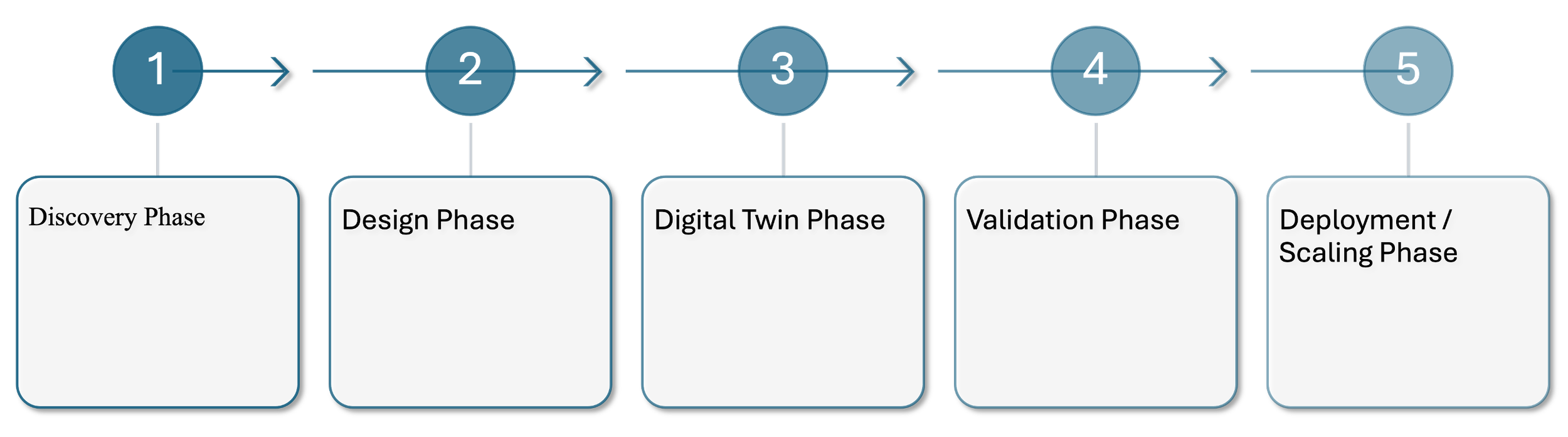
Discovery Phase
The focus is on understanding the constraints of SATCOM (latency, bandwidth) and the hardware limitations of the autonomous assets.
Stakeholder Interviews:
Fleet CISO/Cyber Lead: Focus on current encryption standards, key management lifecycles, and known threat actors.
Naval Ops/Mission Commander: Identify "critical command" thresholds where latency for authentication cannot be tolerated.
SATCOM Provider/Engineer: Analyze packet loss rates, jitter, and available bandwidth for telemetry overhead.
Compliance Officer (CMMC/DoD): Review current NIST 800-171 gaps and CMMC Level 3 requirements.
Artifacts to Collect: Existing SATCOM network topologies, Asset Hardware Specifications (CPU/RAM for PEP deployment), Current IAM/PKI infrastructure, and previous Red Team reports on signal interception.
Design Phase
We will utilize a Maturity Gap Analysis mapping the current "Traditional" state (VPN-based, static trust) to the "Optimal" ZTMM stage:
Identity: From shared keys $\rightarrow$ Unique Machine Identity (mTLS).
Devices: From assumed healthy $\rightarrow$ Continuous posture attestation.
Network: From flat SATCOM tunnels $\rightarrow$ Micro-segmented Software Defined Perimeter (SDP).
Validation/Pilot (Proof of Value)
Scenario: "The Rogue Command Injection"
Setup: A simulated autonomous asset is connected via a high-latency satellite link. An attacker attempts to inject a "Change Course" command using a captured session token.
Pass Criteria:
The PDP (Policy Decision Point) rejects the command due to a lack of continuous authentication.
The Cognitive Engine flags the request as an anomaly based on the asset's current mission profile and geospatial context.
The system triggers an automatic "Safe State" lockdown on the asset.
Deployment & Scaling
Observation Mode: Deploy the Cognitive Layer to baseline "normal" command behavior without blocking.
Shadow Enforcement: PDP evaluates requests; logs "Allow/Deny" but does not drop packets.
Hard Enforcement: Full ZT policy activation, starting with high-risk commands (e.g., data exfiltration, course change).
Architectural Mapping
Logical Layers
Identity Layer: Implements mTLS (mutual TLS) and SPIFFE/SPIRE for workload identity, ensuring the "Command Center" and the "Asset" have cryptographically verifiable identities that rotate frequently.
Network/Transport Layer: A Software Defined Perimeter (SDP) replaces traditional VPNs. The asset is "dark"; it does not listen for connections but initiates an outbound authenticated tunnel to the Controller.
Data & Application Layer: End-to-end encryption (E2EE) of intelligence payloads using AES-256-GCM, with keys managed via a Hardware Security Module (HSM).
Cognitive/Intelligence Layer: The "Brain" that analyzes telemetry to determine if a command—even if authenticated—is logical given the context.
Control Plane vs. Data Plane:
Control Plane: PDP resides at Command HQ; manages policy and trust scores.
Data Plane: PEP (Policy Enforcement Point) resides on the naval asset, executing the "Allow/Deny" decision locally to prevent latency-induced failure.
Reference Diagram Specifications
Logical Architecture: Show a diagram where the PDP sits at HQ and the PEP is embedded in the Asset's onboard computer. The SATCOM link is depicted as an untrusted medium.
Sequence Diagram: Command Center $\rightarrow$ Request Signature $\rightarrow$ PDP (Trust Algorithm) $\rightarrow$ Cognitive Engine (Behavior Check) $\rightarrow$ PEP (Asset) $\rightarrow$ Execution.
Zone Map: Define three zones: Trusted Command Zone, Untrusted Transport Zone (SATCOM), and Hardened Asset Zone.
Representative Technology Stack
| Layer | Category | Example Tool/Vendor |
|---|---|---|
| Identity | Machine ID / PKI | HashiCorp Vault / SPIRE |
| Network | SDP / SASE | Appgate / Zscaler Private Access (Government) |
| Cognitive | UEBA / AI Engine | Darktrace / Custom ML Model (PyTorch/TensorFlow) |
| PEP | Edge Gateway | Ruggedized Linux-based Envoy Proxy / AWS Greengrass |
| Monitoring | SIEM/SOAR | Splunk Enterprise Security / Palo Alto Cortex XSOAR |
Governance & Compliance Framework
Regulatory Alignment
This design is mapped specifically to DoD Zero Trust Reference Architecture and CMMC 2.0 Level 3:
AC.L2-3.1.1 (Access Control): Satisfied by the PDP/PEP architecture ensuring only authorized users/systems access assets.
IA.L2-3.5.3 (Identification & Authentication): Satisfied by mTLS and continuous authentication requirements.
SC.L2-3.13.1 (Boundary Protection): Satisfied by the SDP "Dark Cloud" approach, eliminating open listening ports on naval assets.
Policy Engine Logic: The Trust Algorithm
The PDP will utilize a weighted scoring system to grant access. If the score falls below a threshold ($\tau$), the command is rejected or requires step-up verification.
Trust Score = (W_1 IdConf) + (W_2 DevPost) + (W_3 GeoCtx) + (W_4 * BehRisk)
Identity Confidence (IdConf): Validity of the mTLS certificate and rotation age.
Device Posture (DevPost): Integrity check of the asset's firmware (TPM-based attestation).
Geospatial Context (GeoCtx): Is the command coming from a known HQ coordinate? Does it align with the asset's current GPS location?
Behavioral Risk Score (BehRisk): Analysis by the Cognitive Engine.
Telemetry Analyzed: Command frequency, API call sequences (e.g., "Unlock Payload" immediately following "Change Course"), and packet timing patterns.
Model Type: Isolation Forest / LSTM Autoencoder for anomaly detection against a baseline of mission-specific behavior.
Success Metrics & KPIs
| Metric | Baseline (Traditional) | Target (Zero Trust Cognitive) |
|---|---|---|
| MTTD (Mean Time to Detect) | Days/Weeks (via audit logs) | Seconds (Real-time AI trigger) |
| Attack Surface | Open SATCOM ports / Static VPNs | Zero open ports (Outbound only) |
| Unauthorized Command Rate | Possible via session hijack | ≈ 0 (Continuous Auth required) |
| User Friction Index | Manual key rotations | Transparent mTLS rotation |
| Compliance Score | Partial NIST 800-171 alignment | 100% CMMC 2.0 Level 3 Readiness |
Implementation Roadmap
Horizon 1: Foundation (0–3 Months)
Focus: Identity and Transport Hardening.
Actions: Deploy mTLS across all assets; implement SDP to hide assets from the public SATCOM space.
RACI: Vendor (Lead Design), Client IT (Infrastructure Provisioning).
Horizon 2: Cognitive Integration (3–12 Months)
Focus: Behavioral Baselines and AI Deployment.
Actions: Deploy UEBA sensors to assets; collect telemetry to train the anomaly detection model on "normal" mission profiles.
RACI: Vendor (AI Modeling), Client Ops (Mission Profile Definition).
Horizon 3: Autonomous Maturity (12+ Months)
Focus: Full Adaptive ZT.
Actions: Enable autonomous policy enforcement where the asset can independently reject commands based on the Trust Algorithm without HQ intervention.
RACI: Client Cyber Team (Policy Governance), Vendor (Optimization).
Rough Order of Magnitude (ROM) Investment Model
| Phase | Cost Band | Primary Drivers |
|---|---|---|
| Horizon 1 | Medium | Licensing for SDP, PKI infrastructure setup, Professional Services for deployment. |
| Horizon 2 | High | AI/ML model development, data scientists, high-compute edge hardware upgrades. |
| Horizon 3 | Low/Medium | Ongoing maintenance, policy tuning, annual CMMC audits. |
- SATCOM Data Volume: Increased telemetry for behavioral monitoring may increase satellite bandwidth costs.
- Asset Count: Per-asset licensing for PEP and Identity agents.
Risks, Assumptions & Dependencies
Risk: Latency-Induced Denial of Service. High SATCOM latency could cause the PDP to time out, leading to "False Denials" of critical commands.
Mitigation: Implement Local Policy Caching on the PEP for a set of "Emergency Override" commands.
Assumption: Hardware Capability. We assume naval assets have sufficient onboard compute (e.g., ARM64/x86_64) to run a lightweight PEP and AI inference engine.
Dependency: SATCOM Stability. The system depends on the availability of the satellite link for identity rotation; offline mode policies must be pre-defined.
Appendix
Glossary
ZTA: Zero Trust Architecture.
PDP/PEP: Policy Decision Point / Policy Enforcement Point.
UEBA: User and Entity Behavior Analytics.
mTLS: Mutual Transport Layer Security (both parties authenticate).
SDP: Software Defined Perimeter.
Reference Citations
NIST SP 800-207: Zero Trust Architecture.
CISA ZTMM 2.0: Zero Trust Maturity Model.
CMMC 2.0: Cybersecurity Maturity Model Certification.