

Executive Summary
Problem Statement: Our space surveillance infrastructure—the "eyes" of our orbital security—is currently vulnerable to sophisticated adversaries. A breach in this environment does not merely result in data loss; it creates "Strategic Blindness." By spoofing telemetry or disabling sensors, an adversary can mask the movement of enemy satellites, effectively rendering our Space Situational Awareness (SSA) obsolete and leaving national assets exposed.
Cost of Inaction:
Strategic Failure: Undetected adversary maneuvers in orbit leading to the loss of high-value satellite assets.
Operational Downtime: Total loss of SSA during a coordinated sensor disablement attack.
Contractual/Legal Risk: Non-compliance with CMMC 2.0 and NIST standards, resulting in the immediate revocation of government defense contracts and eligibility for future missions.
Proposed Solution: We will implement a Zero-Trust Cognitive Enterprise (ZTCE) architecture. This shifts security from a "perimeter" model to a "transactional" model. Every single telemetry stream—from the sensor to the analyst's screen—must be continuously verified. We augment this with a Cognitive Layer that uses AI to cross-reference physical orbital mechanics with digital network behavior, ensuring that if data is spoofed, it is detected in milliseconds by its divergence from physical reality.
Expected Outcome: A resilient, self-healing surveillance ecosystem where trust is never assumed, identity is cryptographically proven for every sensor packet, and AI provides a "sanity check" against orbital anomalies, ensuring absolute integrity of Space Situational Awareness.
Customer Engagement Process
The engagement process for deploying a Zero-Trust Cognitive Enterprise (ZTCE) integrated with LLM-enabled knowledge management is a rigorous, five-stage lifecycle designed to eliminate implicit trust while maximizing operational intelligence.
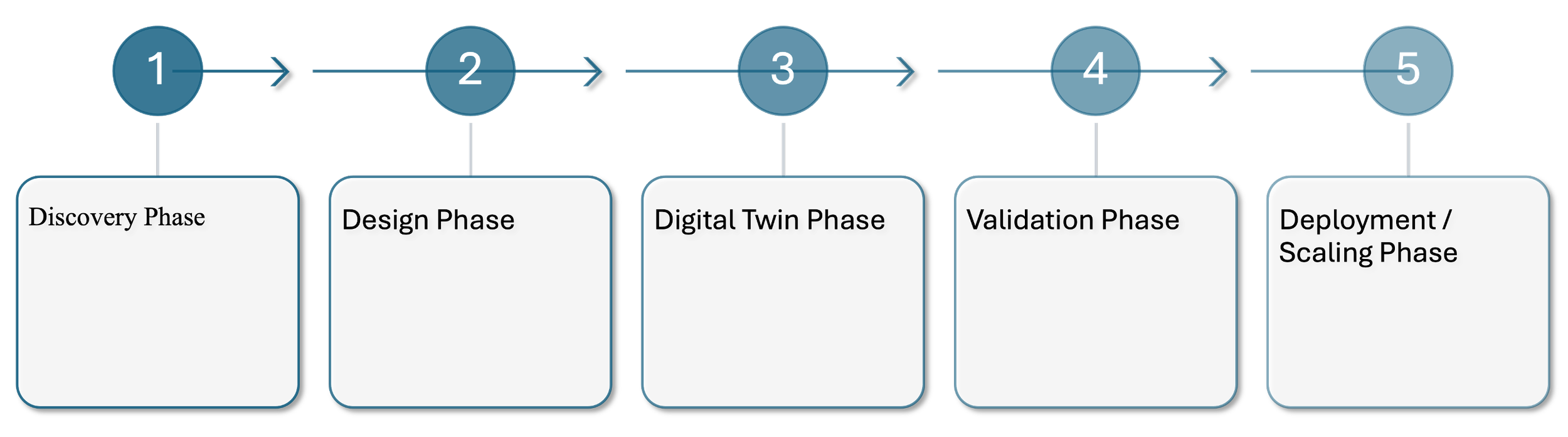
Discovery Phase
The goal is to map the "Telemetry Life Cycle."
Stakeholder Interviews:
CISO: Focus on risk appetite for latency vs. security in real-time streams.
CTO/Chief Architect: Review of legacy sensor protocols (e.g., proprietary RF links) and API gateways.
Space Ops Manager: Define "Normal" orbital behavior and the impact of false positives in anomaly detection.
Compliance Officer: Audit current CMMC 2.0 gaps and NIST SP 800-171 implementation status.
Program Manager (Gov Contracts): Review CDRLs (Contract Data Requirements Lists) for security mandates.
Artifacts to Collect:
Detailed data flow diagrams from Sensor $\rightarrow$ Ground Station $\rightarrow$ Processing Center $\rightarrow$ End User.
Inventory of all "Edge" assets (sensors, antennas, receivers).
Existing IAM policies and PKI (Public Key Infrastructure) certificates.
Design Phase
We utilize a Maturity Gap Analysis mapped to the CISA ZTMM:
Traditional: Implicit trust based on network location (VPN/VLAN).
Initial: Basic MFA and static segmentation.
Advanced: Dynamic policy enforcement; AI-assisted monitoring.
Optimal: Fully autonomous, context-aware access decisions with real-time telemetry validation.
Validation/Pilot (Proof of Value)
Scenario: "The Ghost Satellite" Attack.
Setup: A simulated environment where a malicious actor injects spoofed orbital data into the telemetry stream to mimic a satellite maneuver.
Pass Criteria:
The Identity Layer rejects the packet due to an invalid/expired machine-identity token (PEP block).
If identity is bypassed, the Cognitive Layer flags the data as "Physically Impossible" based on orbital mechanics divergence (Anomaly Detection).
MTTD (Mean Time to Detect) must be $< 5$ seconds from injection.
Deployment & Scaling
Observation Mode: Deploy ZTA agents in "Log-Only" mode to baseline telemetry patterns without blocking traffic.
Shadow Enforcement: Apply policies to a non-critical subset of sensors.
Hard Enforcement: Transition to "Deny-by-Default," where unverified streams are dropped automatically.
Architectural Mapping
Logical Layers
Identity Layer (The Root of Trust): Implements M2M (Machine-to-Machine) Identity. Every sensor is assigned a unique, short-lived cryptographic identity (SPIFFE/SPIRE).
Network/Transport Layer: Transition from flat networks to Micro-segmentation via Software-Defined Perimeter (SDP). Telemetry streams are encapsulated in encrypted tunnels; the sensors are "dark" to the public internet.
Data & Application Layer: API Gateways acting as Policy Enforcement Points (PEP) for all orbital data queries.
Cognitive/Intelligence Layer: The "Brain." This layer analyzes both System Telemetry (CPU, RAM, login patterns) and Payload Telemetry (Orbital state vectors).
Control Plane vs. Data Plane: Separation of the Policy Decision Point (PDP)—where trust is calculated—from the Data Plane (the actual flow of orbital data).
Reference Diagram Specifications
Logical Architecture: A diagram showing sensors $\rightarrow$ PEP (at Ground Station) $\rightarrow$ PDP (Centralized Trust Engine) $\rightarrow$ Analyst Dashboard.
Auth+Authz Sequence:
Sensor requests transmission $\rightarrow$ PDP checks Device Posture + Certificate $\rightarrow$ PDP issues short-lived token $\rightarrow$ PEP allows packet flow $\rightarrow$ Cognitive Layer validates payload physics.
Zone Map: Separation of Sensor Edge Zone, Processing Core Zone, and Management Plane Zone.
Representative Technology Stack
| Layer | Category | Example Tool/Vendor |
|---|---|---|
| Identity | Workload Identity / PKI | SPIFFE/SPIRE, HashiCorp Vault |
| Network | SASE / SDP | Zscaler Private Access, Appgate |
| Data Layer | API Gateway / PEP | Kong Mesh, Apigee |
| Cognitive | UEBA / AI Anomaly Detection | Darktrace, Splunk DSP |
| SIEM/SOAR | Security Orchestration | Palo Alto Cortex XSOAR, Microsoft Sentinel |
Governance & Compliance Framework
Regulatory Alignment
Given the nature of space surveillance, this design maps strictly to:
CMMC 2.0 Level 3 (Expert): Required for protecting Controlled Unclassified Information (CUI) and high-value defense assets. Focuses on advanced persistent threat (APT) protection.
NIST SP 800-207: The foundational blueprint for the Zero Trust Architecture implementation.
NIST SP 800-171: Ensuring the protection of CUI in non-federal systems.
Policy Engine Logic: The Trust Algorithm
Access to telemetry streams is determined by a dynamic score. If the score falls below the threshold, access is revoked or "Step-up" verification (e.g., manual admin override) is required.
Trust Score Formula:
Decision = (ID 0.4) + (Dev_posture 0.3) + (Net_context 0.1) + (Phys_validity * 0.2)
ID_conf (Identity Confidence): Valid mTLS certificate and signed workload identity.
Dev_posture (Device Posture): Firmware version current, no unauthorized process trees running on the sensor controller.
Net_context (Network Context): Source IP matches known ground station coordinates; Geofencing check.
Phys_validity (Physical Validity): The Cognitive Check. Does the orbital data follow Keplerian physics? If a satellite "jumps" 100km in one second, $\text{Phys}_{\text{validity}} = 0$.
Success Metrics & KPIs
| Metric | Baseline (Current) | Target (Post-ZTA) | Measurement Method |
|---|---|---|---|
| MTTD (Spoofing) | Days/Weeks | < 5 Seconds | Red Team injection tests |
| Attack Surface | All ports open on VLAN | 0 open ports (Dark Cloud) | External vulnerability scan |
| User Friction Index | High (Manual VPNs) | Low (Seamless SSO/mTLS) | Help-desk ticket volume Δ |
| CMMC Readiness | Gap identified in 40% of controls | 100% Implementation | Third-party C3PAO Audit |
| AI Precision | N/A | < 1% False Positive Rate | Ratio of alerts to actual anomalies |
Implementation Roadmap
Horizon 1: Foundation (0–3 Months) - "Hardening the Edge"
Focus: Identity and Visibility.
Actions: Deploy SPIFFE/SPIRE for machine identity; implement mTLS between sensors and ground stations; establish CMMC 2.0 baseline.
RACI: Vendor (Lead Design), Client IT (Implementation), Compliance Officer (Audit).
Horizon 2: Intelligence (3–12 Months) - "The Cognitive Shift"
Focus: AI Integration and Micro-segmentation.
Actions: Deploy the Cognitive Layer for orbital anomaly detection; implement SDP to hide sensor infrastructure from the network.
RACI: Vendor (AI Model Tuning), Client Space Ops (Data Labeling), Client IT (Network Migration).
Horizon 3: Autonomy (12+ Months) - "Zero-Touch Resilience"
Focus: Autonomous Response and Optimal Maturity.
Actions: Enable SOAR playbooks to automatically isolate sensors showing physical anomalies; full transition to CISA ZTMM "Optimal" stage.
RACI: Client IT (Maintenance), Vendor (Optimization).
Rough Order of Magnitude (ROM) Investment Model
| Horizon | Cost Band | Primary Drivers | Staffing Estimate |
|---|---|---|---|
| Horizon 1 | Medium | PKI Licensing, Professional Services for CMMC Gap Analysis | 2 FTEs (Security), 1 Consultant |
| Horizon 2 | High | AI/ML Compute Resources, SASE Licensing, Data Engineering | 3 FTEs (DevOps/AI), 2 Consultants |
| Horizon 3 | Low-Medium | Ongoing OpEx for SaaS licenses, Model Retraining | 1 FTE (SRE), 0.5 Consultant |
Risks, Assumptions & Dependencies
Risk: Telemetry Latency. The overhead of mTLS and PDP checks may introduce milliseconds of delay. Mitigation: Use edge-based PEPs to cache authorization decisions.
Risk: Legacy Hardware. Older sensors may not support modern cryptographic agents. Mitigation: Deploy "ZTA Proxies" (Hardware wrappers) at the ground station level.
Assumption: The client provides access to historical orbital data for AI model training/baselining.
Dependency: Availability of high-clearance personnel for system configuration and audit validation.
Appendix
Glossary
ZTA (Zero Trust Architecture): A security model that requires strict identity verification for every person and device trying to access resources on a private network.
PDP/PEP: Policy Decision Point (the "Brain" that decides access) / Policy Enforcement Point (the "Guard" that blocks or allows traffic).
UEBA: User and Entity Behavior Analytics.
SOAR: Security Orchestration, Automation, and Response.
SSA: Space Situational Awareness.
Reference Citations
NIST SP 800-207: Zero Trust Architecture.
CISA ZTMM 2.0: Zero Trust Maturity Model.
CMMC 2.0: Cybersecurity Maturity Model Certification (Level 3).