

Executive Summary
Problem Statement: Current emergency response communication channels rely on perimeter-based security that, once breached, allows lateral movement and the potential for total coordination collapse. In a high-stakes government environment, a single compromised device or credential can lead to the disruption of life-saving services and the leakage of sensitive operational intelligence.
Cost of Inaction: The risk is not merely financial; it is measured in human lives and national security stability. A breach in emergency coordination leads to "dark" communication windows, delayed response times, and the potential for adversarial actors to spoof commands or intercept tactical data, resulting in catastrophic failure of public safety missions.
Proposed Solution: We propose a Zero-Trust Cognitive Enterprise (ZTCE) architecture. Unlike traditional security, this approach assumes the network is already compromised. It implements "Never Trust, Always Verify" through continuous authentication and an AI-driven cognitive layer that monitors behavioral telemetry in real-time. If a device or user deviates from established patterns, the system autonomously contains the threat without requiring human intervention, ensuring that vital communication channels remain available to verified personnel only.
Expected Outcome: A resilient, self-healing communications ecosystem where the "blast radius" of any single compromise is reduced to nearly zero, and mission-critical availability is guaranteed through automated, intelligence-led policy enforcement.
Customer Engagement Process
The engagement process for deploying a Zero-Trust Cognitive Enterprise (ZTCE) integrated with LLM-enabled knowledge management is a rigorous, five-stage lifecycle designed to eliminate implicit trust while maximizing operational intelligence.
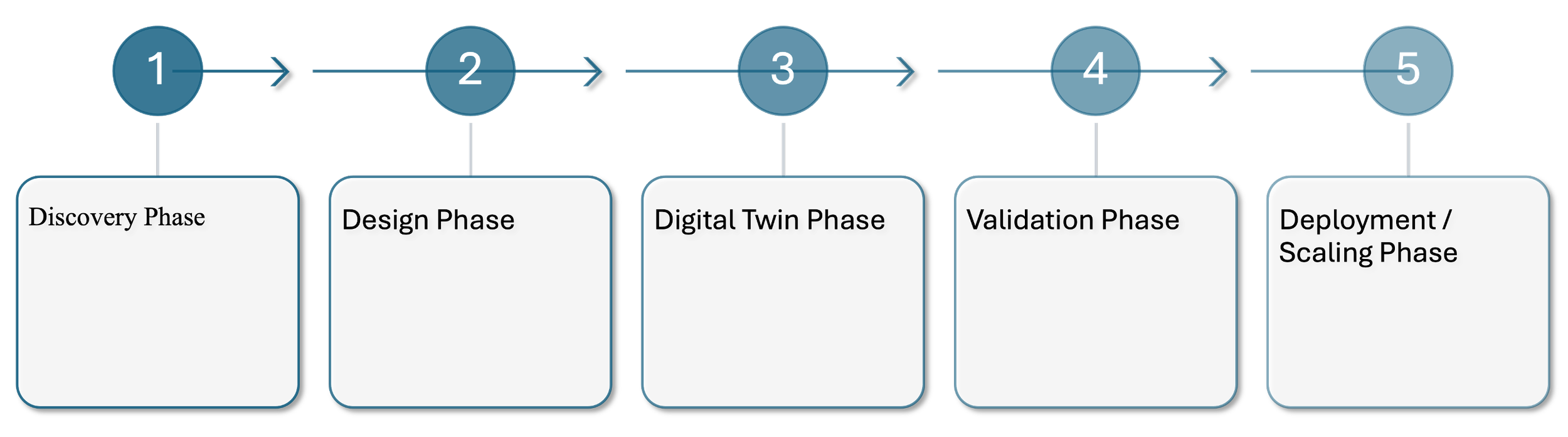
Discovery Phase:
To tailor this design, we will conduct deep-dive sessions with the following stakeholders:
Emergency Management Director: Focus on "Mission Criticality" (Which channels cannot fail under any circumstance?).
CISO/Chief Security Officer: Focus on current threat landscape and existing breach history.
IT Ops & Radio Engineers: Technical audit of P25, LTE-FirstNet, and Satellite communication hand-offs.
Compliance Officer: Review of FISMA, FIPS 140-3, and NIST SP 800-53 requirements.
Program Manager (Gov Contracts): Understanding funding cycles and procurement constraints.
Artifacts to Collect:
Current network topology (including RF/Wireless boundaries).
Asset inventory of field devices (handhelds, tablets, mobile command centers).
Existing Identity & Access Management (IAM) configurations.
Last three audit findings from government oversight bodies.
Design Phase
We will employ a Maturity Gap Analysis mapping the current state against the CISA Zero Trust Maturity Model (ZTMM):
Traditional → Initial: Moving from static passwords to MFA and basic segmentation.
Initial →Advanced: Implementing dynamic policy based on device health and user behavior.
Advanced → Optimal: Achieving fully autonomous, cognitive containment and continuous authentication.
Validation/Pilot (Proof of Value)
A high-fidelity PoV will be executed using a "Red Team" scenario:
Scenario: A field tablet is "stolen" (simulated compromise). The attacker attempts to access the tactical coordination channel from an unauthorized geolocation while mimicking a known user.
Pass/Fail Criteria:
The Cognitive Engine must detect the anomaly within $<30$ seconds.
The Policy Decision Point (PDP) must trigger an automatic "Step-up" authentication request.
Upon failure of step-up auth, the device must be logically isolated from the network (Automated Containment) without impacting other active field units.
Deployment & Scaling
Phase 1: Shadow Mode. Deploy cognitive sensors to observe baseline behavior without enforcing blocks.
Phase 2: Selective Enforcement. Apply ZT policies to high-risk/high-value channels first.
Phase 3: Full Hardening. Move to "Default Deny" across the entire communications estate.
Architectural Mapping
Logical Layers
Identity Layer: Phishing-resistant MFA (FIDO2) and continuous session validation via cryptographically bound tokens.
Network/Transport Layer: Software-Defined Perimeter (SDP) creating "Black Cloud" infrastructure where resources are invisible until authenticated.
Data & Application Layer: End-to-end encryption (E2EE) for all voice/data, with micro-segmentation separating Administrative traffic from Tactical Emergency traffic.
Cognitive/Intelligence Layer: The "Brain" that ingests telemetry to calculate trust scores in real-time.
Control Plane vs. Data Plane: Strict separation; the Control Plane (PDP) manages policy, while the Data Plane (PEP) executes it at the edge.
Reference Diagram Specifications
(a) Logical Architecture: A diagram showing the Policy Decision Point (PDP) centrally managing policies and the Policy Enforcement Points (PEP)situated at every entry point: the mobile device, the radio gateway, and the cloud application.
(b) Auth+Authz Sequence: A flow showing: User Request $\rightarrow$ PEP Intercept $\rightarrow$ PDP Trust Calculation (Identity + Device + Behavior) $\rightarrow$ Grant/Deny Decision $\rightarrow$ Encrypted Tunnel Establishment.
(c) Zone Map: Visual separation of the Untrusted Zone (Public Internet/Field), the Transit Zone (SASE/SDP Gateway), and the Trusted Resource Zone (Command & Control Servers).
Representative Technology Stack
| Layer | Product Category | Example Vendor/Tool |
|---|---|---|
| Identity | Cloud IdP / Passwordless MFA | Okta, Azure AD, YubiKey |
| Device | UEM / Endpoint Security | VMware Workspace ONE, CrowdStrike Falcon |
| Network | SASE / SDP / ZTNA | Zscaler, Cloudflare One, Appgate |
| Intelligence | UEBA / Cognitive Engine | Exabeam, Securonix, Darktrace |
| Operations | SIEM / SOAR | Splunk + Phantom, Google Chronicle |
| Gateway | API Gateway / Mesh | Kong, Istio (for microservices) |
Governance & Compliance Framework
Regulatory Alignment
This design is mapped specifically to the following mandates:
NIST SP 800-207: The foundational blueprint for ZTA implementation.
FIPS 140-3: Ensuring all cryptographic modules used in emergency comms meet federal standards.
FISMA / NIST SP 800-53: Implementing security controls specifically for Federal Information Systems.
Policy Engine Logic (The Trust Algorithm)
Access is not a binary "yes/no" but a dynamic score. The PDP calculates the Trust Score {T} as follows:
{T} = (W_i IdentityConf) + (W_d DevicePosture) + (W_l GeoContext) + (W_b * BehavioralRisk)
Variables:
Identity Confidence: Strength of MFA used + time since last re-auth.
Device Posture: OS patch level, EDR status, presence of corporate certificate.
GeoContext: Is the device in a known operational area? (e.g., GPS drift detection).
Behavioral Risk: Deviation from historical API call patterns or signal timing.
Adaptive Triggers:
T > 80: Full Access granted.
50 < T < 80: Step-up authentication required (e.g., Biometric prompt).
T < 50: Immediate session termination and automated containment.
Success Metrics & KPIs
| Metric | Baseline (Traditional) | Target (Cognitive ZTA) | Measurement Method |
|---|---|---|---|
| MTTD (Mean Time to Detect) | Hours/Days | < 5 Minutes | SIEM Alert Timestamp vs. Event Start |
| MTTR (Mean Time to Respond) | Manual Intervention | < 60 Seconds | Automated Containment Log Entry |
| Attack Surface | Open VPN Ports / Static IPs | ≈ 0 (Dark Cloud) | External Port Scanning/Recon Analysis |
| User Friction Index | Daily Password Resets | ≈ 1 Auth per shift | Help-desk ticket volume for MFA/Login |
| Compliance Score | Periodic Audit Checklists | Continuous Compliance | Real-time NIST 800-53 Control Dashboard |
Implementation Roadmap
Horizon 1: Foundation (0–3 Months)
Focus: Visibility and Identity Hardening.
Actions: Deploy phishing-resistant MFA; conduct full asset discovery of all communication endpoints; implement basic micro-segmentation for the Command Center.
RACI: Vendor: Architecture design, Tool deployment. Client: Asset inventory, Stakeholder access.
Horizon 2: Cognitive Integration (3–12 Months)
Focus: Dynamic Policy and Behavioral Analysis.
Actions: Deploy SDP/ZTNA to replace legacy VPNs; integrate UEBA engine to ingest telemetry from field devices; implement the Trust Algorithm for tactical channels.
RACI: Vendor: AI model tuning, PDP configuration. Client: Operational baseline definition.
Horizon 3: Autonomous Resilience (12+ Months)
Focus: Full ZT Maturity and Self-Healing.
Actions: Enable automated containment (SOAR playbooks); transition to continuous authentication; expand ZTA to all peripheral government coordination partners.
RACI: Vendor: Optimization, Advanced Threat Hunting. Client: Governance oversight, Audit validation.
Rough Order of Magnitude (ROM) Investment Model
| Horizon | Licensing Costs | Professional Services | Staffing/FTE Est. | Total Band |
|---|---|---|---|---|
| Horizon 1 | Medium (Per seat MFA/IdP) | High (Initial Design) | Low (Admin support) | Medium |
| Horizon 2 | High (SASE + UEBA) | Medium (Integration) | Medium (SOC Analysts) | High |
| Horizon 3 | Medium (Maintenance) | Low (Optimization) | Medium (ZTA Lead) | Medium |
- SIEM Ingestion Volume: Higher telemetry from cognitive sensors increases data costs.
- Per-Seat Licensing: SASE and IdP costs scale linearly with the number of field personnel.
- Hardware Refresh: Potential need to upgrade legacy radios to support modern encryption/SDP clients.
Risks, Assumptions & Dependencies
Key Assumptions
Field devices have sufficient compute power to run SDP clients and EDR agents.
Network connectivity (LTE/Sat) is available for the Control Plane heartbeat.
Top Delivery Risks & Mitigations
Risk: False Positive Containment. AI blocks a legitimate emergency call during a crisis.
Mitigation: Implement a "Break-Glass" override protocol and a phased transition from Shadow Mode to Enforcement.
Risk: Legacy Hardware Incompatibility. Old radio systems cannot support ZTA agents.
Mitigation: Use PEP Gateways (proxies) that wrap legacy traffic in a Zero Trust tunnel at the network edge.
Risk: Resistance to Change. Field personnel find continuous auth cumbersome.
Mitigation: Prioritize "invisible" telemetry (behavioral/device health) over frequent manual prompts.
Appendix
Glossary of Acronyms
ZTA: Zero Trust Architecture
PDP / PEP: Policy Decision Point / Policy Enforcement Point
UEBA: User and Entity Behavior Analytics
SOAR: Security Orchestration, Automation, and Response
SDP: Software-Defined Perimeter
SASE: Secure Access Service Edge
Reference Citations
NIST SP 800-207: Zero Trust Architecture (The primary standard for the PDP/PEP model).
CISA ZTMM 2.0: Zero Trust Maturity Model (Used for the Traditional $\rightarrow$ Optimal roadmap).
FIPS 140-3: Federal Information Processing Standard (Ensuring cryptographic integrity of communication).