

Executive Summary
Problem Statement
The electrical grid relies on Industrial Control Systems (ICS) and SCADA networks that were originally designed for connectivity and reliability, not security. Currently, many substations operate on a "trusted perimeter" model; once an attacker breaches the outer network or compromises a technician's credentials, they can issue fraudulent commands to Programmable Logic Controllers (PLCs) and Intelligent Electronic Devices (IEDs). A single malicious command—such as opening a circuit breaker under load—can trigger cascading failures, leading to widespread blackouts, economic paralysis, and threats to public safety.
The Cost of Inaction
Operational Impact: Potential for multi-state power outages affecting millions of citizens and critical services (hospitals, water treatment).
Regulatory Penalty: Severe non-compliance fines from NERC CIP (North American Electric Reliability Corporation Critical Infrastructure Protection) reaching millions of dollars per day/violation.
Financial Loss: Massive revenue loss due to downtime and the extreme cost of physical equipment replacement if hardware is damaged by malicious switching.
Proposed Solution
We propose a Cognitive Zero-Trust Architecture (ZTA). This approach removes "implicit trust" from the network. Every command sent to a substation—whether from a human operator or an automated system—must be dynamically verified. By integrating a Cognitive Intelligence Layer, the system doesn't just check who is sending the command, but if the command makes sense given the current physical state of the grid and historical behavioral patterns.
Expected Outcome
The transformation from a perimeter-based defense to a data-centric, cognitive defense ensures that fraudulent commands are intercepted in milliseconds, isolating compromised segments automatically before a local failure becomes a regional blackout.
Customer Engagement Process
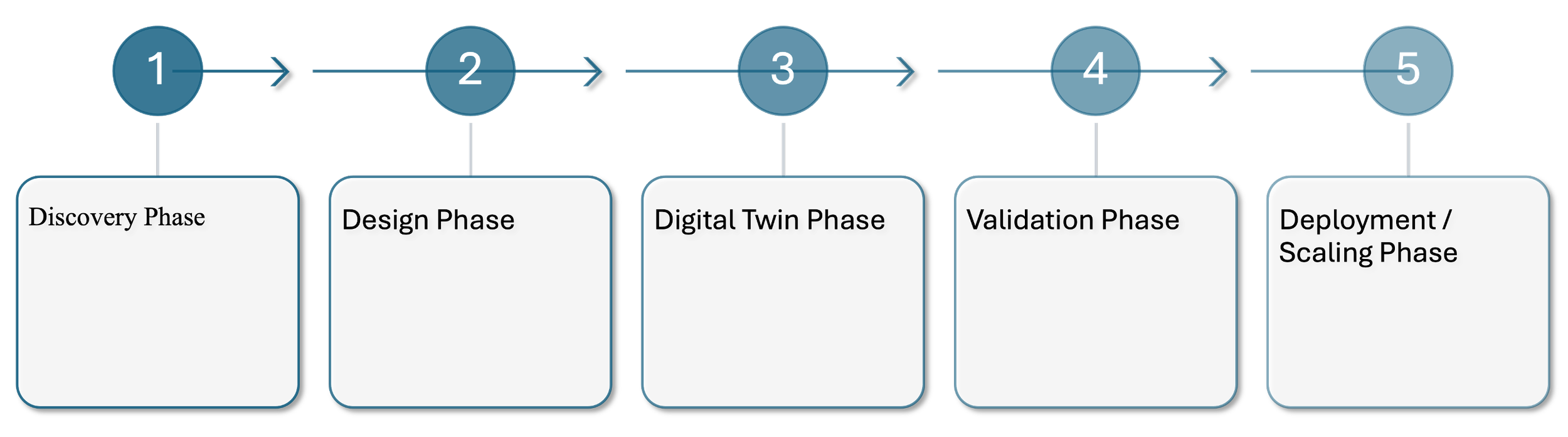
The engagement process for deploying a Zero-Trust Cognitive Enterprise (ZTCE) integrated with LLM-enabled knowledge management is a rigorous, five-stage lifecycle designed to eliminate implicit trust while maximizing operational intelligence.
Discovery Phase
To build the blueprint, we will conduct targeted interviews and evidence collection:
Stakeholder Interviews:
CISO/CTO: Alignment on risk appetite and convergence of IT (Information Technology) and OT (Operational Technology).
Grid Operations Manager: Understanding "Criticality Levels" of substations and acceptable latency for command verification.
Compliance Officer: Review of NERC CIP audit gaps and reporting requirements.
Field Engineers: Assessment of legacy hardware capabilities (e.g., which IEDs support encrypted protocols vs. plain-text DNP3/Modbus).
Artifact Collection:
Current network topology (L2/L3 diagrams) and "One-Line" electrical diagrams.
Asset Inventory: List of all PLCs, RTUs, and HMI software versions.
Existing IAM configurations (Active Directory, LDAP) and VPN access logs.
Design Phase
We utilize a Maturity Gap Analysis based on the CISA Zero Trust Maturity Model (ZTMM):
Traditional: Static passwords, flat OT networks, perimeter firewalls.
Initial: MFA for remote access, basic VLAN segmentation.
Advanced: Identity-based access, automated telemetry collection.
Optimal: Dynamic policy enforcement based on real-time cognitive risk scores (The Target State).
Validation/Pilot (Proof of Value)
A "Sandbox Substation" environment will be used to test the Cognitive Command Validator.
Scenario: A simulated compromised Operator Workstation attempts to send a "Trip Breaker" command during a period of peak load without a corresponding maintenance ticket.
Pass Criteria: The system must detect the anomaly via the Cognitive Layer, trigger a "Step-up Authentication" challenge to the operator, and block the command if validation fails—all within $<100\text{ms}$.
Deployment & Scaling
Observation Mode (Shadow): Deploy sensors to baseline "normal" grid behavior without blocking commands.
Selective Enforcement: Apply ZT policies to the most critical substations first.
Full Orchestration: Move to a hard-enforcement model across the entire footprint.
Architectural Mapping
Logical Layers
Identity Layer: Transition from IP-based trust to Machine Identity. Every PLC and HMI is assigned a unique, cryptographically verifiable identity (SPIFFE/SPIRE or X.509 certificates).
Network/Transport Layer: Implementation of a Software Defined Perimeter (SDP). The substation network remains "dark" to unauthorized users; tunnels are created on-demand only after authentication.
Data & Application Layer: Micro-segmentation at the process level. Communication is restricted to specific function codes (e.g., "Read Only" for monitoring, "Write" only for authorized controllers).
Cognitive/Intelligence Layer: The "Brain" that monitors telemetry and correlates it with grid physics.
Control Plane vs. Data Plane:
Control Plane: Where the Policy Decision Point (PDP) resides (Centralized Security Ops).
Data Plane: Where the Policy Enforcement Points (PEP) reside (Substation Gateways/Firewalls).
Reference Diagram Specifications
Logical Architecture: A diagram showing the PDP in the Control Center communicating via a secure channel to PEPs located at each substation entrance, effectively creating a "Micro-Perimeter" around every IED.
Sequence Diagram (Auth+Authz):
Operator $\rightarrow$ Request Command $\rightarrow$ PEP (Intercept) $\rightarrow$ PDP (Check Identity + Device Health) $\rightarrow$ Cognitive Engine (Analyze Grid State/Behavior) $\rightarrow$ Decision (Allow/Deny/Challenge) $\rightarrow$ PEP (Execute/Block).Zone Map: A Purdue Model-aligned map showing the separation of Level 0 (Process), Level 1 (Basic Control), Level 2 (Area Supervisory Control), and Level 3 (Site Operations).
Representative Technology Stack
| Layer | Category | Example Technology/Vendor |
|---|---|---|
| Identity | IdP / Machine Identity | Okta, HashiCorp Vault, Ping Identity |
| Network | SASE / SDP / Micro-segmentation | Akamai Guardicore, Zscaler, Palo Alto Prisma |
| OT Security | ICS Visibility & Threat Detection | Nozomi Networks, Dragos, Claroty |
| Intelligence | UEBA / Cognitive Analysis | Splunk Enterprise Security + AI, Darktrace OT |
| Enforcement | Industrial Firewalls/Gateways | Cisco ISA, Fortinet Rugged |
Governance & Compliance Framework
Regulatory Alignment
This design is mapped specifically to:
NERC CIP (002-014): Specifically addressing Electronic Security Perimeters (ESP) and Access Control.
NIST SP 800-207: Implementing the core tenets of Zero Trust (assume breach, verify explicitly).
NIST SP 800-82: Tailoring security controls for Industrial Control Systems.
Policy Engine Logic: The Trust Algorithm
The PDP will utilize a weighted trust score to decide if a command is executed. If the score falls below a threshold ($\text{T}$), the command is blocked or sent for manual override.
Trust Score = (W_1 IdConf) + (W_2 DevPost) + (W_3 NetCtx) + (W_4 * CogScore)
Variables:
Identity Confidence (IdConf}: MFA status, role-based permissions.
Device Posture (DevPost): Patch level of the workstation, presence of EDR.
Network Context (NetCtx): Source IP/Geo-location, time of day vs. shift schedule.
Cognitive Score (CogScore): The AI's analysis of the command sequence.
Adaptive Triggers:
If CogScore is low (anomaly detected) but other factors are high →Trigger Step-up MFA.
If DevPost is critical (malware detected on workstation) → Immediate Block & Isolate.
Success Metrics & KPIs
| Metric | Baseline (Current State) | Target (Future State) | Measurement Method |
|---|---|---|---|
| MTTD (Fraudulent Command) | Hours/Days (Post-incident) | < 500ms | Log analysis of PEP interception. |
| Attack Surface | Open ports for DNP3/Modbus | 0 open ports (SDP Tunnels) | Port scanning / Asset discovery. |
| User Friction Index | Low (Single login) | Medium (Contextual MFA) | Average auth prompts per shift. |
| Compliance Score | Partial NERC CIP Alignment | 100% Audit Readiness | External audit/gap assessment. |
| False Positive Rate | N/A | < 0.1% | Ratio of blocked legitimate commands. |
Implementation Roadmap
Horizon 1: Visibility & Hardening (0-3 Months)
Focus: "See everything." Deploy passive OT monitoring to map all assets and baseline traffic.
Quick Wins: Implement MFA for all remote access; disable unused services on PLCs.
RACI: Vendor (Lead Design), Client IT (Infrastructure Support).
Horizon 2: Cognitive Integration & Identity (3-12 Months)
Focus: "Verify everything." Deploy Machine Identities and the Cognitive Intelligence Layer in "Observation Mode."
Key Milestone: Migration of all operator access to an SDP/ZTNA framework.
RACI: Vendor (AI Tuning), Client OT Ops (Validation).
Horizon 3: Autonomous Resilience (12+ Months)
Focus: "Isolate everything." Enable active blocking and autonomous segment isolation based on Cognitive scores.
Key Milestone: Full ZT Maturity—no implicit trust remains in the substation network.
Rough Order of Magnitude (ROM) Investment Model
| Horizon | Estimated Cost Band | Primary Drivers | Resource Requirement |
|---|---|---|---|
| Horizon 1 | Low - Medium | Sensor licensing, Professional Services for mapping. | 2 FTEs (Client), Vendor Architect. |
| Horizon 2 | Medium - High | SDP Licenses, IdP migration, AI model training/tuning. | 4 FTEs (Client), Integration Partner. |
| Horizon 3 | Medium | Annual subscriptions, Managed SOC (MDR) for OT. | 1 FTE (Admin), MSSP. |
Risks, Assumptions & Dependencies
Key Assumptions:
The client has a reasonably accurate asset inventory.
Existing network hardware supports VLANs or is replaceable via the ROM budget.
Dependencies:
Hardware Compatibility: Some legacy IEDs may not support modern encryption; these will require "Bump-in-the-wire" (BITW) security gateways.
Operational Buy-in: Grid operators must accept a slight change in workflow (MFA/Validation).
Top Risks & Mitigations:
Latency Injection: ZT verification could delay critical commands. $\rightarrow$ Mitigation: Deploy PDPs geographically closer to substations (Edge Computing).
False Positives (Blocking Legitimate Commands): AI blocks a valid emergency command during a grid crisis. $\rightarrow$ Mitigation: Implement a "Break-Glass" physical override for authorized personnel.
Protocol Incompatibility: Legacy protocols (Modbus) are inherently insecure. $\rightarrow$ Mitigation: Encapsulate legacy traffic in encrypted ZT tunnels at the gateway level.
Appendix
Glossary of Acronyms
ZTA: Zero Trust Architecture
PDP/PEP: Policy Decision Point / Policy Enforcement Point
UEBA: User and Entity Behavior Analytics
SCADA: Supervisory Control and Data Acquisition
IED/PLC: Intelligent Electronic Device / Programmable Logic Controller
NERC CIP: North American Electric Reliability Corporation Critical Infrastructure Protection
Reference Citations
NIST SP 800-207: Zero Trust Architecture.
CISA ZTMM 2.0: Zero Trust Maturity Model.
NERC CIP Standards: Requirements for BES (Bulk Electric System) Cyber Systems.