

Executive Summary
Problem Statement
Modern logistics rely on a vast, interconnected web of sensors and third-party vendor access points. Currently, these systems often operate on "flat" networks where a single compromised sensor or a stolen vendor credential can grant an attacker lateral movement across the entire logistics grid. The result is not merely a data breach, but the potential for physical accidents, systemic gridlock, and the total paralysis of services.
The Cost of Inaction
A successful disruption of city logistics carries catastrophic risks:
Economic Impact: Millions of dollars in lost productivity per hour of systemic gridlock.
Public Safety: Increased response times for emergency vehicles, leading to potential loss of life.
Liability & Trust: Massive legal exposure following physical accidents caused by cyber-manipulation and a total collapse of public confidence in smart-city infrastructure.
Proposed Solution
We propose a Zero-Trust Cognitive Enterprise (ZTCE) framework. Unlike traditional security that protects the "perimeter," ZTCE assumes the network is already compromised. It implements a "Never Trust, Always Verify" model for every single sensor, API call, and vendor login. By integrating a Cognitive Intelligence layer, the system doesn't just check passwords—it monitors the behavior of the infrastructure in real-time to detect and block anomalies before they manifest as physical failures.
Expected Outcome
The transition from a perimeter-based defense to a Zero-Trust architecture will eliminate implicit trust, isolate compromised components automatically, and ensure that transportation systems remain resilient even during an active cyber-attack.
Customer Engagement Process
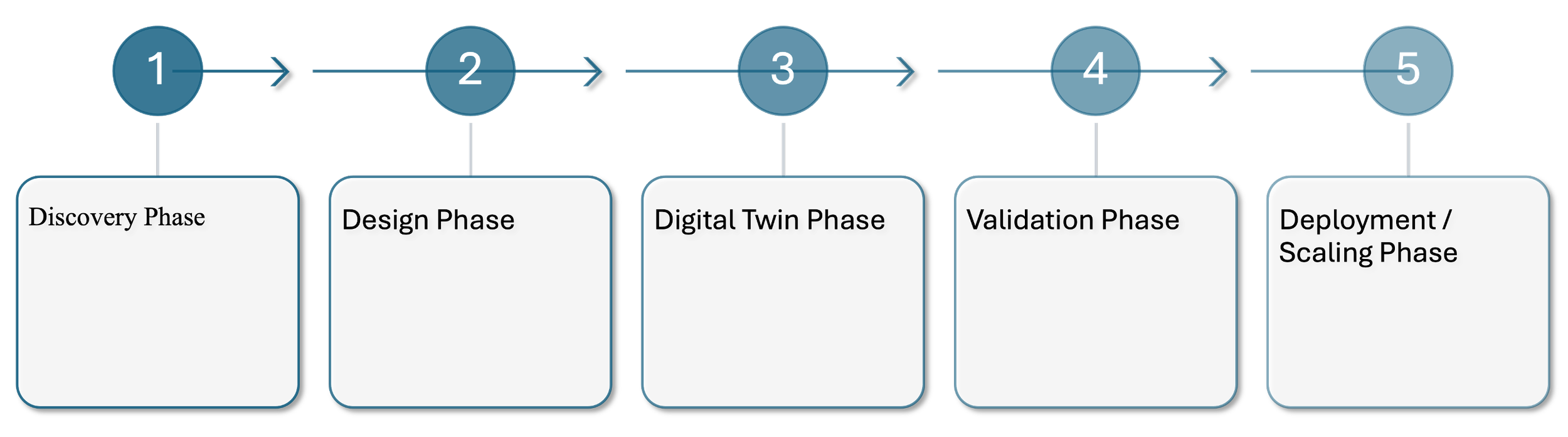
The engagement process for deploying a Zero-Trust Cognitive Enterprise (ZTCE) integrated with LLM-enabled knowledge management is a rigorous, five-stage lifecycle designed to eliminate implicit trust while maximizing operational intelligence.
Discovery Phase
To build a tailored blueprint, we will conduct targeted interviews and evidence collection:
Stakeholder Interviews:
CISO/Security Director: Focus on current threat landscape, previous incident reports, and risk appetite.
Director of Transportation (COO): Identify "Crown Jewel" assets (e.g., bridge controls, signal timing servers) where downtime is unacceptable.
IoT/OT Operations Manager: Understand the lifecycle of sensors, firmware update processes, and legacy protocol usage (e.g., Modbus, BACnet).
Compliance Officer: Review municipal regulations and critical infrastructure mandates (e.g., TSA Security Directives or NIST CSF).
Vendor Program Manager: Audit existing third-party SLAs and remote access methods.
Artifacts to Collect:
Comprehensive Asset Inventory (Hardware/Software/Firmware versions of all IoT endpoints).
Current Network Topology Diagrams (highlighting IT/OT convergence points).
Existing IAM configurations and Vendor Access Lists.
Last three Third-Party Audit or Penetration Test findings.
Design Phase
We will employ a Maturity Gap Analysis based on the CISA Zero Trust Maturity Model (ZTMM), mapping current capabilities across five pillars:
Identity: Moving from shared passwords $\rightarrow$ Phishing-resistant MFA and Machine Identities.
Devices: Moving from unknown assets $\rightarrow$ Continuous posture assessment of IoT sensors.
Networks: Moving from flat VLANs $\rightarrow$ Micro-segmentation and Software-Defined Perimeters (SDP).
Applications/Workloads: Moving from open APIs $\rightarrow$ Granular, identity-aware API gateways.
Data: Moving from cleartext $\rightarrow$ End-to-end encryption for sensor telemetry.
Validation/Pilot (Proof of Value)
Scenario: "The Rogue Sensor Injection"
Setup: Introduce a simulated compromised IoT sensor attempting to send an unauthorized "Green Light" command or fake traffic congestion data to the central controller.
Pass Criteria:
The Policy Decision Point (PDP) denies the request based on lack of valid mTLS certificate.
The Cognitive Layer flags the behavior as an anomaly (atypical command sequence).
The system automatically triggers a "Quarantine" state for that specific sensor without impacting adjacent sensors.
Deployment & Scaling
A phased rollout to ensure zero interruption to city traffic:
Phase A (Shadow Mode): Deploy ZT policies in "Alert Only" mode. Monitor logs to ensure legitimate traffic isn't blocked.
Phase B (Pilot Zone): Enforce hard Zero-Trust policies in one non-critical district or a single transportation corridor.
Phase C (Enterprise Rollout): Iterative expansion across the city, moving from lowest to highest criticality assets.
Architectural Mapping
Logical Layers
Identity Layer: The root of trust. Every human and every sensor is assigned a unique, cryptographically verifiable identity.
Network/Transport Layer: Transition from traditional VPNs to an SDP (Software Defined Perimeter) where resources are "dark" until authenticated.
Data & Application Layer: API Gateways act as the Policy Enforcement Points (PEP), ensuring only authorized identities can call specific functions.
Cognitive/Intelligence Layer: The "Brain" that analyzes telemetry to adjust trust scores dynamically.
Control Plane vs. Data Plane: Separation of the management traffic (PDP) from the actual sensor data flow (PEP).
Reference Diagram Specifications
Logical Architecture: A diagram showing the Policy Decision Point (PDP) centrally managing policies, with Policy Enforcement Points (PEPs) placed at the edge (e.g., IoT Gateways, API Gateways, and SASE connectors) intercepting all requests.
Auth+Authz Sequence: A flow starting from a Vendor Login $\rightarrow$ MFA Challenge $\rightarrow$ Device Posture Check $\rightarrow$ PDP Trust Calculation $\rightarrow$ Temporary Session Token issuance $\rightarrow$ Access to specific IoT Controller.
Segmentation Map: A "Hub-and-Spoke" model where each sensor group (e.g., Traffic Lights, Bridge Sensors) resides in its own micro-segment, with no lateral communication allowed between segments without PDP approval.
Representative Technology Stack
| Layer | Category | Example Tools/Vendors |
|---|---|---|
| Identity | IdP / Machine Identity | Okta, Ping Identity, HashiCorp Vault (for mTLS) |
| Device | MDM / EDR for IoT | Microsoft Defender for IoT, Armis, Forescout |
| Network | SASE / SDP | Zscaler, Cloudflare One, Appgate |
| Intelligence | UEBA / SIEM | Splunk + Phantom, Exabeam, Darktrace |
| Application | API Gateway / PEP | Kong, Apigee, AWS API Gateway |
Governance & Compliance Framework
Regulatory Alignment
Given the critical infrastructure nature of transportation, this design aligns with:
NIST SP 800-207: The foundational blueprint for Zero Trust Architecture.
CISA ZTMM 2.0: Used to benchmark maturity levels (Initial $\rightarrow$ Optimal).
TSA Security Directives / NIST CSF: Ensuring compliance with federal mandates for critical transportation infrastructure protection.
CMMC 2.0 (Level 2): Applied specifically if the city manages federally funded defense-related logistics or ports.
Policy Engine Logic: The Trust Algorithm
Access is not binary; it is a calculated score. The PDP uses the following weighted logic:
Trust Score = (W_1 IdConf) + (W_2 DevPost) + (W_3 Ctx) + (W_4 * BehRisk)
Identity Confidence (IdConf): Is the MFA phishing-resistant? Is the mTLS certificate valid?
Device Posture (DevPost): Is the sensor running approved firmware? Is it in a known physical location (Geo-fencing)?
Context (Ctx): Is this access happening during a scheduled maintenance window?
Behavioral Risk (BehRisk): Is the sensor sending packets at an unusual frequency or using unexpected opcodes?
Adaptive Triggers:
Score > 90: Full Access.
Score 60-89: Step-up authentication required (e.g., second admin approval).
Score < 60: Immediate block and trigger incident response ticket.
Success Metrics & KPIs
| Metric | Baseline (Current State) | Target (Future State) |
|---|---|---|
| MTTD (Mean Time to Detect) | Days/Weeks (via manual audit) | Minutes (via Cognitive UEBA) |
| MTTR (Mean Time to Respond) | Hours (manual port shutdown) | Seconds (Automated Quarantine) |
| Attack Surface Reduction | Flat network / Open ports | 90% reduction in visible internal services |
| User Friction Index | Constant VPN logins/timeouts | Seamless SSO + Risk-based MFA |
| Compliance Score | Partially compliant (Gap exists) | 100% alignment with NIST 800-207 / CISA ZTMM |
Implementation Roadmap
Horizon 1: Visibility & Foundation (0-3 Months)
Goal: Eliminate blind spots and secure the "front door."
Actions: Full IoT asset discovery; Deployment of MFA for all vendor access points; Implementation of basic logging/SIEM ingestion.
RACI: Vendor (Lead Design), Client IT (Asset Inventory), CISO (Policy Approval).
Horizon 2: Cognitive Integration & Segmentation (3-12 Months)
Goal: Move from "Permissive" to "Restrictive" access.
Actions: Rollout of mTLS for sensors; Implementation of micro-segmentation via SDP; Activation of UEBA behavioral baselining for IoT telemetry.
RACI: Vendor (Implementation), Client Ops (Testing), Security Team (Monitoring).
Horizon 3: Autonomous Resilience (12+ Months)
Goal: Self-healing infrastructure.
Actions: Full transition to the dynamic Trust Algorithm; Automated "Kill-Switch" orchestration for anomalous endpoints; Continuous compliance auditing.
RACI: Client Security Team (Owner), Vendor (Optimization/Support).
Rough Order of Magnitude (ROM) Investment Model
| Horizon | Cost Band | Primary Drivers |
|---|---|---|
| Horizon 1 | Medium | Licensing for IdP/MFA, Professional Services for Discovery. |
| Horizon 2 | High | SASE/SDP Infrastructure, Edge Gateway upgrades, UEBA licensing. |
| Horizon 3 | Low-Medium | Maintenance, Fine-tuning AI models, Annual audit fees. |
- SIEM Ingestion: Costs scale with the volume of telemetry data from IoT sensors.
- Per-Seat Licensing: MFA and SASE costs scale by number of users/vendors.
- Hardware Refresh: Legacy sensors requiring "ZT-Proxy" gateways to support mTLS.
Risks, Assumptions & Dependencies
Key Assumptions
The client has a centralized management capability for IoT firmware updates.
Vendor contracts can be amended to require the use of the city's ZT access portal.
Top Delivery Risks & Mitigations
Legacy Incompatibility: Some sensors may not support modern encryption/mTLS.
Mitigation: Deploy ZT-Proxies (Hardware PEPs) in front of legacy devices to wrap traffic in encrypted tunnels.
Operational Disruption: Overly aggressive policies could block critical traffic signals.
Mitigation: Use the "Shadow Mode" phase and implement a "Fail-Open" safety override for life-critical systems.
Vendor Resistance: Third parties may resist using new authentication tools.
Mitigation: Mandate ZT access as a contractual requirement for all future service agreements.
Appendix
Glossary of Acronyms
ZTA: Zero Trust Architecture
PDP / PEP: Policy Decision Point / Policy Enforcement Point
UEBA: User and Entity Behavior Analytics
SOAR: Security Orchestration, Automation, and Response
mTLS: Mutual Transport Layer Security (Both client and server verify certificates)
SDP: Software Defined Perimeter
Reference Citations
NIST SP 800-207: Zero Trust Architecture.
CISA ZTMM 2.0: Zero Trust Maturity Model.
CMMC 2.0: Cybersecurity Maturity Model Certification.