

Executive Summary
Problem Statement: Water utility infrastructure is currently facing an elevated threat landscape where adversaries target the convergence of Information Technology (IT) and Operational Technology (OT). The primary risk is "lateral movement," where a breach in the corporate office network allows an attacker to pivot into the Industrial Control Systems (ICS), potentially manipulating chemical dosing levels or triggering system-wide outages. Such an event poses a direct threat to public safety, environmental health, and regulatory standing.
Cost of Inaction: A successful compromise could result in catastrophic public health crises, massive environmental remediation costs, severe legal penalties under critical infrastructure protection mandates, and the complete loss of public trust. Furthermore, unplanned downtime for water services results in immediate economic loss for the municipality and surrounding industries.
Proposed Solution: We propose a Zero Trust Cognitive Enterprise (ZTCE) framework. Unlike traditional "perimeter" security, this approach assumes the network is already compromised. It implements strict micro-segmentation to isolate critical OT processes and deploys an AI-driven cognitive layer that monitors the "heartbeat" of the water system. By analyzing real-time telemetry, the system can detect and block unauthorized changes to chemical setpoints or valve states in milliseconds—even if the attacker has stolen valid credentials.
Expected Outcome: The transition from a "trust-but-verify" model to a "never trust, always verify" model, resulting in a resilient infrastructure where IT breaches are contained and OT process integrity is autonomously guaranteed.
Customer Engagement Process
The engagement process for deploying a Zero-Trust Cognitive Enterprise (ZTCE) integrated with LLM-enabled knowledge management is a rigorous, five-stage lifecycle designed to eliminate implicit trust while maximizing operational intelligence.
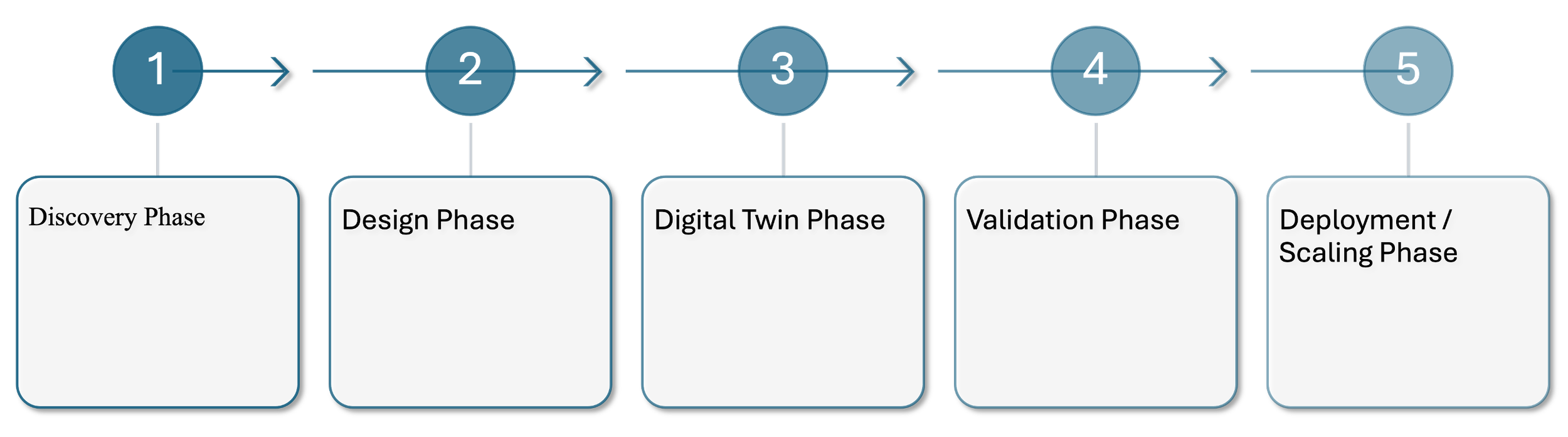
Discovery Phase: The focus is on mapping the "Crown Jewels"—the specific PLCs (Programmable Logic Controllers) and HMIs (Human Machine Interfaces) that control chemical levels and flow.
Stakeholder Interviews:
CISO/IT Director: Current IAM maturity, existing firewall rules between IT/OT, and incident response playbooks.
Plant Manager/OT Lead: Critical process thresholds (e.g., chlorine limits), legacy hardware constraints, and maintenance windows.
Compliance Officer: Alignment with EPA guidelines, AWIA (America's Water Infrastructure Act), and NIST CSF.
Program Manager: Budgetary cycles and operational uptime requirements.
Artifacts Collection:
Purdue Model network diagrams.
Asset inventory (firmware versions of PLCs, RTUs).
Current firewall rule-sets (IT $\rightarrow$ OT).
Historical logs of "unexplained" process anomalies.
Design Phase
We will employ a Gap Analysis mapping the current state against the CISA Zero Trust Maturity Model (ZTMM):
Traditional → Initial: Moving from flat networks to basic VLANs and MFA for remote access.
Initial → Advanced: Implementing identity-based micro-segmentation and centralized policy management.
Advanced → Optimal: Integrating AI/ML cognitive telemetry for autonomous policy adjustment based on process behavior.
Digital Twin Prototyping and System DevelopmentPhase: Leveraging high-performance HAAES DAVIS hardware to create a high-fidelity virtual replica of the customer's environment; this allows for the development and stress-testing of the cognitive engine and LLM performance in a sandboxed ecosystem that mirrors real-world telemetry.
Validation/Pilot (Proof of Value): A 30-day PoV focusing on the Cognitive Component:
Scenario: "Unauthorized Setpoint Manipulation."
Setup: A mirrored lab environment containing a representative PLC controlling a chemical feed.
Test: An authorized user account is "compromised" and attempts to change the chlorine level beyond a safe threshold.
Pass Criteria: The Cognitive Layer must detect the anomaly based on behavioral drift (not just credentials) and the Policy Decision Point (PDP) must trigger an immediate block or step-up authentication request before the command reaches the PLC.
Deployment & Scaling
Visibility Mode: Deploy sensors to map all East-West traffic without blocking.
Shadow Mode: AI generates "Alert Only" notifications for policy violations to tune out false positives.
Enforcement Mode: Phased rollout of hard micro-segmentation, starting with the most critical chemical dosing loops.
Architectural Mapping
Logical Layers
Identity Layer: Transition from shared passwords to Machine-to-Machine (M2M) identities using certificates (x.509) for all PLC-to-HMI communication.
Network/Transport Layer: Implementation of a Software-Defined Perimeter (SDP). The "Dark Cloud" approach ensures OT assets are invisible to the IT network until authenticated.
Data & Application Layer: Deep Packet Inspection (DPI) of industrial protocols (Modbus/TCP, DNP3, EtherNet/IP) to ensure only valid function codes are sent.
Cognitive/Intelligence Layer: The "Brain" that correlates IT login behavior with OT process changes.
Control Plane vs. Data Plane: Separation of the Policy Decision Point (PDP)—where the AI resides—from the Policy Enforcement Points (PEP), such as industrial firewalls and switches.
Reference Diagram Specifications
Logical Architecture: A diagram showing the PDP centrally managing multiple PEPs located at the IT/OT boundary and between different "Cells" (e.g., Filtration Cell, Chemical Treatment Cell).
Transaction Sequence: User $\rightarrow$ Request to change setpoint $\rightarrow$ PEP intercepts $\rightarrow$ PDP queries AI Engine (Behavioral Risk) + IdP (Identity Confidence) $\rightarrow$ Decision (Allow/Deny/Step-up) $\rightarrow$ Command sent to PLC.
Zone Map: A map based on the Purdue Model, showing micro-segments for "Critical Process," "Supervisory Control," and "Enterprise IT."
Representative Technology Stack
| Layer | Category | Example Tools/Vendors |
|---|---|---|
| Identity | IdP / PKI | Okta, Microsoft Entra ID, HashiCorp Vault (for M2M) |
| Network | SASE / SDP | Zscaler, Palo Alto Prisma Access, Akamai |
| OT Security | Industrial DPI/IDS | Nozomi Networks, Claroty, Dragos |
| Cognitive | UEBA / AI Engine | Darktrace OT, Splunk Enterprise Security (with MLTK) |
| Enforcement | Industrial Firewall | Fortinet Rugged, Cisco ISA Series |
Governance & Compliance Framework
Regulatory Alignment
NIST SP 800-207: The foundational blueprint for the ZTA implementation.
CISA ZTMM 2.0: Used to track maturity across the five pillars.
NIST SP 800-82: Guide to Industrial Control Systems (ICS) Security.
AWIA / EPA Requirements: Ensuring water quality reporting and risk assessment compliance.
Policy Engine Logic (The Trust Algorithm)
Access is not binary; it is a calculated score.
Trust Score = (W_1 IdConf) + (W_2 DevPost) + (W_3 NetCtx) + (W_4 * ProcState)
Identity Confidence ($\text{IdConf}$): MFA status, role-based access (RBAC).
Device Posture ($\text{DevPost}$): Managed vs. Unmanaged device, patched status.
Network Context ($\text{NetCtx}$): Source IP, Geolocation, Time of Day.
Process State ($\text{ProcState}$): (The Cognitive Variable) Is the requested change consistent with current water chemistry trends and historical norms?
Adaptive Triggers:
If Trust Score < Threshold, trigger Step-up MFA (Biometric).
If ProcState indicates a "Critical Danger" value, the PDP issues an Immediate Block, regardless of Identity confidence.
Success Metrics & KPIs
| Metric | Baseline (Current) | Target (Post-Implementation) |
|---|---|---|
| MTTD (Mean Time to Detect) | Weeks/Months (via audit) | Seconds/Minutes (via AI) |
| Attack Surface | Flat Network (Open IT → OT) | 90% reduction in reachable OT ports |
| Unauthorized Changes | Undetected until process failure | 100% alerted/blocked in real-time |
| User Friction Index | Low (Password only) | Moderate (MFA for critical changes only) |
| Compliance Score | Partial / Manual | ≥ 95% Automated Control Validation |
Implementation Roadmap
Horizon 1: Visibility & Hardening (0-3 Months)
Goal: Eliminate "blind spots" and secure the perimeter.
Actions: Deploy OT visibility sensors; implement MFA for all remote VPN access; conduct full asset discovery.
RACI: Vendor (Lead Design), Client IT (Execution), Plant Ops (Access Provisioning).
Horizon 2: Micro-segmentation & Identity (3-12 Months)
Goal: Stop lateral movement.
Actions: Deploy PEPs between OT cells; migrate to M2M certificates for PLC communication; implement the PDP/PEP logic flow.
RACI: Vendor (Architecture), Client IT (Network Config), Plant Ops (Testing/Validation).
Horizon 3: Cognitive Autonomy (12+ Months)
Goal: Predictive and autonomous protection.
Actions: Integrate AI engine with process telemetry; automate "block" actions for anomalous parameter changes; full ZTMM "Optimal" stage alignment.
RACI: Vendor (AI Tuning), Client IT/OT (Governance).
Rough Order of Magnitude (ROM) Investment Model
| Horizon | Cost Band | Primary Drivers | Staffing Needs |
|---|---|---|---|
| Horizon 1 | Low - Medium | Sensor licenses, Initial Audit services | 0.5 FTE IT, Vendor Consultant |
| Horizon 2 | Medium - High | Industrial Firewalls, IdP Licensing, Professional Services | 1.0 FTE IT, OT Engineer (Part-time) |
| Horizon 3 | Medium | AI Model training, SIEM ingestion volume | Managed Security Service Provider (MSSP) |
Risks, Assumptions & Dependencies
Key Assumptions
The client has a basic inventory of IP-enabled assets in the OT environment.
Management supports "blocking" mode for security, accepting potential (though minimized) operational friction.
Critical Dependencies
OT Downtime Windows: Implementation of PEPs requires scheduled outages for hardware installation.
Telemetry Availability: AI effectiveness depends on the ability to mirror traffic from legacy switches (SPAN/TAP).
Top Delivery Risks & Mitigations
Risk: Legacy PLCs may crash when scanned or subjected to DPI.
Mitigation: Use passive monitoring first; validate all tools in a lab environment.
Risk: False positives blocking critical water flow commands.
Mitigation: Extended "Shadow Mode" period and human-in-the-loop overrides for emergency scenarios.
Risk: Resistance from OT staff regarding IT-led security changes.
Mitigation: Include Plant Managers in the design phase to ensure operational continuity is prioritized.
Appendix
Glossary
ZTA: Zero Trust Architecture.
PDP/PEP: Policy Decision Point / Policy Enforcement Point.
UEBA: User and Entity Behavior Analytics.
SOAR: Security Orchestration, Automation, and Response.
PLC/HMI: Programmable Logic Controller / Human Machine Interface.
DNP3/Modbus: Common industrial communication protocols.
Reference Citations
NIST SP 800-207: Zero Trust Architecture.
CISA ZTMM 2.0: Zero Trust Maturity Model.
CMMC 2.0: Cybersecurity Maturity Model Certification (Applied here for high-assurance control standards).
NIST SP 800-82: Guide to Industrial Control Systems Security.