

Executive Summary
Problem Statement: In pharmaceutical manufacturing, the convergence of corporate IT networks and factory-floor Operational Technology (OT) has created a critical vulnerability. A security breach in the corporate office can now pivot into the production environment, allowing attackers to alter chemical formulas or temperature set-points. Such an event leads to "batch spoilage"—the loss of millions of dollars in product—and risks patient safety and severe regulatory sanctions from bodies like the FDA.
The Cost of Inaction: A single successful pivot from IT to OT can result in total batch loss, multi-month production downtime for forensic cleaning/re-validation, and potential loss of manufacturing licenses due to GxP (Good Practice) non-compliance.
Proposed Solution: We propose a Zero-Trust Cognitive Enterprise framework. This approach removes the "implicit trust" usually granted to anyone inside the factory network. By implementing strict micro-segmentation, we isolate production cells from the rest of the company. Furthermore, we integrate an AI-driven "Cognitive Layer" that monitors the actual behavior of industrial controllers in real-time, automatically blocking any unauthorized changes to critical process parameters before they can spoil a batch.
Expected Outcome: A resilient production environment where identity is verified at every step, lateral movement is mathematically restricted, and AI provides a final safety net against both external attackers and insider threats.
Customer Engagement Process
The engagement process for deploying a Zero-Trust Cognitive Enterprise (ZTCE) integrated with LLM-enabled knowledge management is a rigorous, five-stage lifecycle designed to eliminate implicit trust while maximizing operational intelligence.
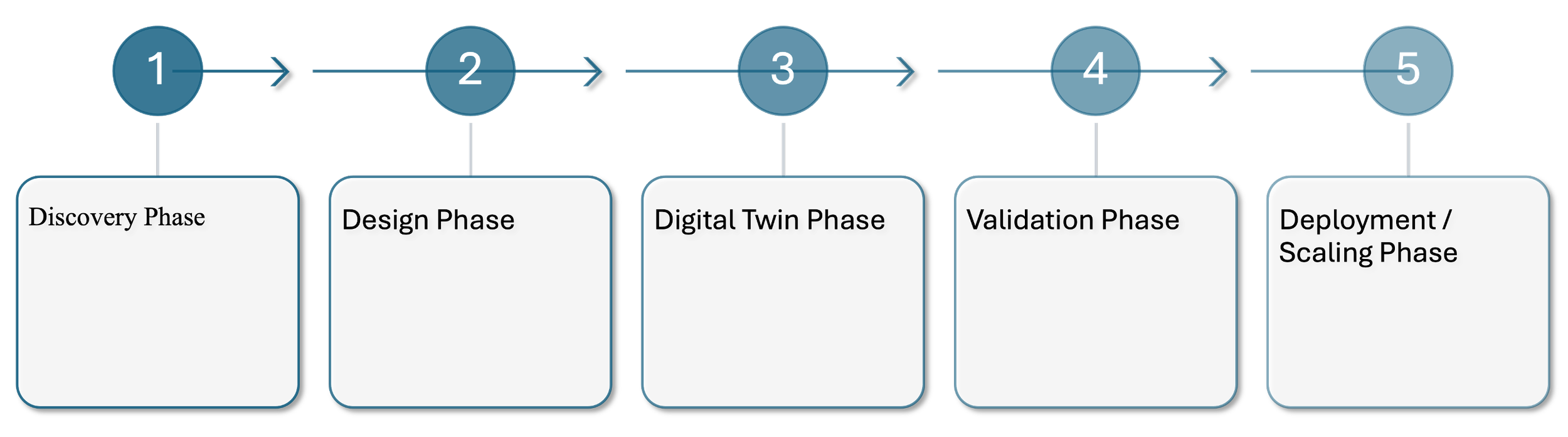
Discovery Phase
The goal is to map the "Crown Jewels" (Critical Process Parameters) and the paths leading to them.
Stakeholder Interviews:
CISO: Focus on risk appetite, current visibility gaps in OT, and reporting requirements for board-level risk.
VP of Manufacturing/Ops: Focus on uptime requirements, "no-touch" windows, and the impact of false positives (unintended blocks) on production.
Quality Assurance (QA) & Compliance Officer: Focus on 21 CFR Part 11 requirements, electronic signature mandates, and GxP validation protocols.
OT Engineer/Program Manager: Focus on legacy PLC protocols (Modbus, S7, EtherNet/IP), network topology, and existing safety instrumented systems (SIS).
Artifacts to Collect:
Current Purdue Model network diagrams.
Asset inventory (PLC types, firmware versions, HMI software).
Existing IAM configurations for jump hosts.
Previous FDA/EMA audit findings related to data integrity.
Design Phase
We will utilize a Gap Analysis Mapping against the CISA Zero Trust Maturity Model (ZTMM):
Traditional →Initial: Moving from flat VLANs to identity-based access for jump hosts.
Initial → Advanced: Implementing micro-segmentation at the Cell/Area level and integrating UEBA.
Advanced → Optimal: Achieving autonomous, AI-driven policy enforcement where the system blocks parameter changes based on behavioral anomalies without human intervention.
Validation / Pilot (Proof of Value)
Scenario: "The Rogue Parameter Change."
Setup: A mirrored staging environment containing one PLC and one HMI.
Test: An authorized user account is compromised; the attacker attempts to change a critical temperature set-point outside of the validated range during a simulated batch run.
Pass/Fail Criteria:
The AI Cognitive Layer must detect the anomaly within $<2$ seconds.
The PEP (Policy Enforcement Point) must block the write command based on the "Trust Algorithm."
An alert must be triggered in the SIEM with full telemetry of the attempted change.
Deployment & Scaling
Phase 1: Visibility Mode. Deploy sensors to map all OT traffic without blocking (Shadow Mode).
Phase 2: Identity Hardening. Enforce MFA for all IT-to-OT transitions via a secure jump server.
Phase 3: Micro-segmentation. Isolate production lines into "Zones" and "Conduits" per ISA/IEC 62443.
Phase 4: Cognitive Enforcement. Enable AI-driven blocking of unauthorized parameter changes.
Architectural Mapping
Logical Layers
Identity Layer: Centralized Identity Provider (IdP) extending to OT via a Privileged Access Management (PAM) gateway.
Network/Transport Layer: Software-Defined Perimeter (SDP) and micro-segmentation using identity-based firewalls at the Cell level.
Data & Application Layer: GxP data integrity vault; encrypted communication between Historians and ERP systems.
Cognitive/Intelligence Layer: An OT-specific IDS/UEBA engine analyzing industrial protocols for behavioral anomalies.
Control Plane (PDP): The Policy Decision Point that evaluates the Trust Algorithm.
Data Plane (PEP): The Policy Enforcement Points (Firewalls, Switches, API Gateways) that execute the PDP's decision.
Reference Diagram Specifications
Logical Architecture: A diagram showing a centralized Policy Engine (PDP) in the IT cloud/datacenter connected via an encrypted tunnel to Industrial Firewalls (PEPs) situated between the Plant Network (Level 3) and the Cell Area (Level 2).
Auth+Authz Sequence: User $\rightarrow$ MFA $\rightarrow$ PAM Gateway $\rightarrow$ PDP (Checks: Identity + Device Health + Time of Day) $\rightarrow$ PEP $\rightarrow$ PLC Access granted for specific Read/Write operations.
Network Zone Map: A "Hub-and-Spoke" model where each production line is its own micro-segment, separated by a PEP, with all traffic routed through an inspection point.
Representative Technology Stack
| Layer | Category | Example Vendor/Tool |
|---|---|---|
| Identity | IdP / MFA | Azure AD / Okta + Duo |
| Privileged Access | PAM | CyberArk / BeyondTrust |
| Network Security | SASE / SDP | Zscaler / Palo Alto Prisma Access |
| OT Visibility/AI | OT-IDS / UEBA | Claroty / Nozomi Networks |
| Micro-segmentation | Industrial Firewall | Cisco ISA / Fortinet Rugged |
| Monitoring | SIEM / SOAR | Splunk + Phantom / Microsoft Sentinel |
Governance & Compliance Framework
Regulatory Alignment
FDA 21 CFR Part 11: Ensuring that the ZTA logs provide an immutable audit trail of who changed what parameter and when (Electronic Records/Signatures).
GxP (Good Manufacturing Practice): Maintaining "Validated State." Any change to the network architecture is documented via Change Control to ensure production quality is not impacted.
NIST SP 800-82: Applying Guide to Industrial Control Systems (ICS) security to ensure ZTA does not introduce latency that impacts real-time safety functions.
Policy Engine Logic (The Trust Algorithm)
Access to OT assets is determined by a dynamic score. If the score falls below the threshold, access is denied or "Step-up" authentication is required.
Trust Score = (W_1 * IdConf) + (W_2 * DevPost) + (W_3 * NetCtx) + (W_4 * BehRisk)
Identity Confidence (IdConf): MFA status, role-based access (RBAC).
Device Posture (DevPost): Patch level of the engineering workstation, presence of EDR.
Network Context (NetCtx): Is the request coming from a known jump host or an unexpected internal IP?
Behavioral Risk Score (BehRisk): (Cognitive Input) Does this specific PLC write command deviate from the historical baseline for this batch phase?
Trigger: If BehRisk indicates a "High Anomaly" (e.g., changing temperature by 20 degrees in 1 second, the PDP issues an immediate Block command to the PEP, regardless of identity confidence.
Success Metrics & KPIs
| Metric | Baseline (Traditional) | Target (Zero Trust Cognitive) |
|---|---|---|
| MTTD (OT Anomaly) | Days/Weeks (via audit logs) | < 5 Minutes (Real-time AI alert) |
| Attack Surface | Flat Network (Any-to-Any) | Micro-segmented (Least Privilege) |
| Unauthorized Changes | Detected post-batch spoilage | Blocked pre-execution |
| User Friction Index | High (VPNs/Shared Passwords) | Low (SSO + Adaptive Auth) |
| Compliance Score | Manual evidence gathering | Automated, real-time audit reports |
Implementation Roadmap
Horizon 1: Visibility & Foundation (0–3 Months)
Goal: Eliminate blind spots and secure the perimeter.
Actions: Deploy OT sensors for asset discovery; implement MFA on all IT $\rightarrow$ OT jump hosts.
RACI: Vendor (Lead Design), Client IT (Implementation), Client OT (Asset Validation).
Horizon 2: Segmentation & Intelligence (3–12 Months)
Goal: Stop lateral movement and baseline behavior.
Actions: Deploy industrial firewalls for micro-segmentation; train AI models on "Normal" batch parameter sequences.
RACI: Vendor (AI Tuning), Client OT (Defining "Normal"), Client IT (Network Config).
Horizon 3: Cognitive Autonomy (12+ Months)
Goal: Real-time autonomous protection.
Actions: Shift AI from "Alert Only" to "Active Blocking"; integrate SOAR playbooks for automated incident response.
RACI: Vendor (Optimization), Client CISO (Governance Approval).
Rough Order of Magnitude (ROM) Investment Model
| Horizon | Licensing Cost | Professional Services | Staffing/FTE | Total Band |
|---|---|---|---|---|
| Horizon 1 | Medium (IdP, Sensors) | Medium (Discovery) | Low (IT Admin) | Low-Medium |
| Horizon 2 | High (Firewalls, AI) | High (Engineering) | Medium (OT Sec Analyst) | High |
| Horizon 3 | Medium (Maintenance) | Low (Tuning) | Medium (SOC/OT Ops) | Medium |
- Ingestion Volume: SIEM costs scale with the number of OT telemetry points monitored.
- Hardware: Number of physical industrial firewalls required per production cell.
- Validation: Cost of GxP re-validation for every segmented zone.
Risks, Assumptions & Dependencies
Risk: Legacy Incompatibility. Some older PLCs may not support encrypted traffic or may crash under intensive scanning. Mitigation: Use passive monitoring and hardware-based transparent bridges.
Assumption: Downtime Windows. It is assumed the client can provide scheduled maintenance windows for PEP installation.
Dependency: Data Quality. The AI's ability to block spoilage depends on having clean, historical "Golden Batch" data to establish a baseline.
Risk: False Positives. An AI-driven block during a critical phase could cause the very downtime it seeks to prevent. Mitigation: Implement a "Human-in-the-loop" confirmation for 3 months before full autonomy.
Appendix
Glossary
ZTA: Zero Trust Architecture.
PDP/PEP: Policy Decision Point / Policy Enforcement Point.
UEBA: User and Entity Behavior Analytics.
GxP: General Good Practices (e.g., GMP - Good Manufacturing Practice).
PLC: Programmable Logic Controller.
HMI: Human Machine Interface.
Reference Citations
NIST SP 800-207: Zero Trust Architecture.
CISA ZTMM 2.0: Zero Trust Maturity Model.
ISA/IEC 62443: Security for Industrial Automation and Control Systems.
FDA 21 CFR Part 11: Electronic Records; Electronic Signatures.