

Executive Summary
Problem Statement
Your organization operates in a high-stakes environment where the theft of intellectual property (IP) or the subtle manipulation of component manufacturing data could lead to catastrophic mission failure and the loss of critical government contracts. Traditional "perimeter" security is insufficient; once an attacker breaches the outer wall, they have unfettered access to the production floor and sensitive blueprints.
Cost of Inaction
Contractual Loss: Failure to meet CMMC 2.0 requirements results in immediate disqualification from Department of Defense (DoD) contracts.
Operational Sabotage: A breach of integrity in mission-critical components could lead to physical failure of aerospace assets, resulting in loss of life and massive legal liability.
Strategic Erosion: Theft of IP by nation-state actors erodes the competitive advantage and national security posture.
Proposed Solution
We propose a Zero-Trust Cognitive Enterprise framework. This approach removes "implicit trust" from the network. Whether a request comes from a CEO’s laptop or a CNC machine on the factory floor, it must be continuously verified. By implementing micro-segmentation, we isolate production zones so that a breach in one area cannot spread to another. We augment this with an AI-driven "Cognitive Layer" that monitors behavioral patterns in real-time to stop attackers who have stolen valid credentials but are acting maliciously.
Expected Outcome
A resilient manufacturing environment where IP is cryptographically isolated, production integrity is guaranteed through continuous verification, and the organization achieves a "Ready" status for CMMC 2.0 Level 2 audits.
Customer Engagement Process
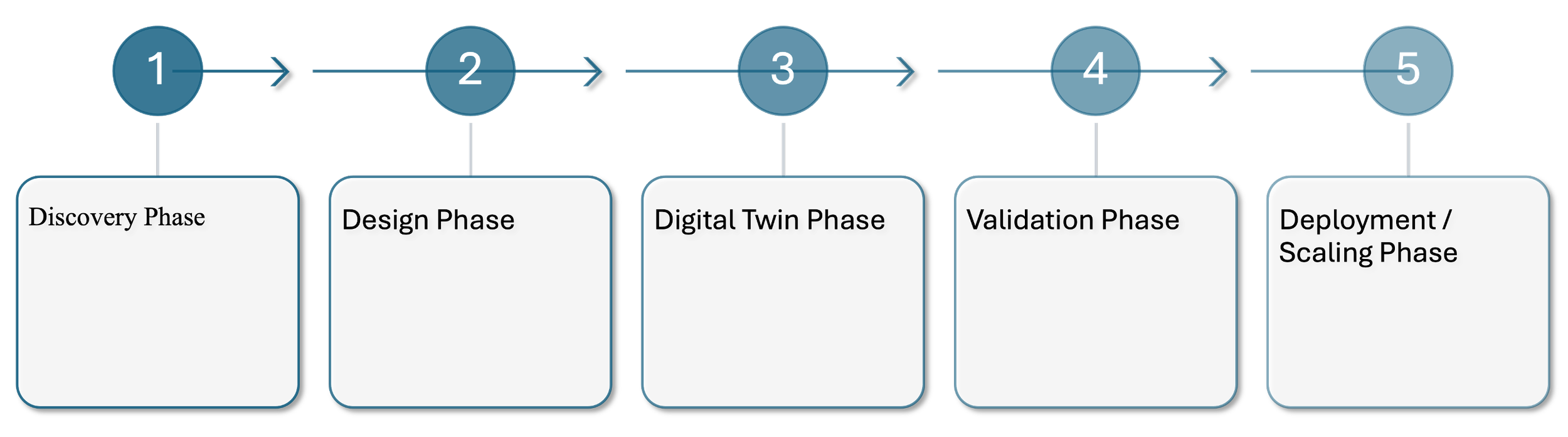
The engagement process for deploying a Zero-Trust Cognitive Enterprise (ZTCE) integrated with LLM-enabled knowledge management is a rigorous, five-stage lifecycle designed to eliminate implicit trust while maximizing operational intelligence.
Discovery Phase
To move from generic requirements to a tailored blueprint, we will conduct targeted interviews and artifact collection:
CISO/Security Team: Review existing IAM policies, current incident response playbooks, and known gaps in the current security stack.
CTO/IT Ops: Map the hybrid environment (Cloud PLM vs. On-prem ERP) and identify legacy "unpatchable" systems on the factory floor.
Plant Manager/OT Engineer: Identify critical production cells, PLC/SCADA versions, and the impact of latency on real-time manufacturing processes.
Compliance Officer/Gov Program Mgr: Review current CUI (Controlled Unclassified Information) boundaries and previous NIST SP 800-171 self-assessments.
Artifacts to Collect:
Detailed network topology diagrams (IT and OT).
CUI Data Flow Map (where blueprints move from design $\rightarrow$ production $\rightarrow$ archive).
Asset Inventory (including firmware versions of industrial controllers).
Existing Identity Provider (IdP) configurations.
Design Phase: Maturity Mapping
We will utilize the CISA Zero Trust Maturity Model (ZTMM) to map the transition:
Traditional: Flat network, password-based auth, perimeter firewalls.
Initial: MFA implemented for remote access; basic VLAN segmentation.
Advanced: Identity-based micro-segmentation; automated policy updates.
Optimal: Fully autonomous cognitive response; continuous adaptive trust scoring for all entities (Human and Machine).
Validation/Pilot (Proof of Value)
A 30-day PoV focusing on one "High-Value Production Cell."
Scenario: An attacker gains access to an engineer's credentials and attempts to modify a CNC machine configuration file.
Pass Criteria: The AI Cognitive Layer must detect the anomaly (unusual time of day + unusual command sequence) and trigger a Step-Up authentication or block the request via the PEP, despite the credentials being "valid."
Deployment & Scaling
Observation Mode: Deploy sensors to baseline "normal" behavior without blocking.
Shadow Policy: Run ZT policies in parallel with legacy rules; log discrepancies.
Hard Enforcement: Transition to "Deny-by-Default," starting with the most sensitive IP zones and moving outward.
Architectural Mapping
Logical Layers
Identity Layer: The primary perimeter. Implements phishing-resistant MFA (FIDO2) for humans and SPIFFE/SPIRE identities for machine-to-machine (M2M) communication between PLCs and MES.
Network/Transport Layer: Transition from VLANs to a Software Defined Perimeter (SDP). All traffic is encrypted in transit via mTLS.
Data & Application Layer: Micro-segmentation of the "Production Zone." Applications are isolated into "Protect Surfaces" containing only the minimum necessary assets.
Cognitive/Intelligence Layer: The "Brain" that feeds the Trust Algorithm. It analyzes telemetry from across all layers to adjust trust scores dynamically.
Control Plane vs. Data Plane:
Control Plane: Where the Policy Decision Point (PDP) resides, calculating access based on the Trust Algorithm.
Data Plane: Where the Policy Enforcement Points (PEPs)—such as API Gateways and Micro-firewalls—execute the PDP's decision.
Reference Diagram Specifications
Logical Architecture: A hub-and-spoke model where all requests to a Production Cell must pass through a PEP. The PEP queries the central PDP, which in turn queries the Cognitive Engine for a real-time risk score.
Auth+Authz Sequence:
User Request $\rightarrow$ PEP (Intercept) $\rightarrow$ PDP (Evaluate Policy) $\rightarrow$ Cognitive Engine (Risk Score)$\rightarrow$ Identity Provider (Verify Creds) $\rightarrow$ PDP (Final Decision) $\rightarrow$ PEP (Allow/Deny).Zone Map: Division of the plant into "Cells" (e.g., Milling Cell, Assembly Cell, Testing Cell), each separated by a micro-segmentation gateway, with a dedicated "Management Zone" for updates.
Representative Technology Stack
| Layer | Category | Example Tooling/Vendors |
|---|---|---|
| Identity | IdP / MFA | Okta, Microsoft Entra ID, Yubico (FIDO2) |
| Network | SASE / SDP | Zscaler, Cloudflare One, Appgate |
| OT Security | Industrial IDS/IPS | Nozomi Networks, Dragos, Claroty |
| Cognitive | UEBA / AI Engine | Exabeam, Darktrace, Splunk UEBA |
| Enforcement | API Gateway / Micro-FW | Kong, HashiCorp Consul, VMware NSX |
| Governance | GRC Platform | ServiceNow IRM, OneTrust |
Governance & Compliance Framework
Regulatory Alignment
IEC 62443: The primary standard for Industrial Automation and Control Systems (IACS). We map ZTA micro-segmentation to "Zones and Conduits" requirements.
NIST SP 800-82: Guide to Industrial Control Systems (ICS) security.
TISAX (Trusted Information Security Assessment Exchange): Ensuring automotive supply chain data protection.
Policy Engine Logic (The Trust Algorithm)
Access is not binary; it is a calculated score. If the score falls below the threshold, access is denied or stepped-up MFA is required.
$$\text{Trust Score} = (W_1 \cdot \text{IdConf}) + (W_2 \cdot \text{DevPost}) + (W_3 \cdot \text{NetCtx}) + (W_4 \cdot \text{BehavRisk})$$
Variables:
Identity Confidence (IdConf): Is the user/machine authenticated via MFA/Certificate?
Device Posture (DevPost): Is the tablet/workstation patched and free of malware?
Network Context (NetCtx): Is the request coming from a known internal VLAN or an authorized VPN?
Behavioral Risk (BehavRisk): Does this command (e.g., Write_Single_Register) fit the current state of the assembly line?
Adaptive Triggers:
If BehavRisk spikes (e.g., a sudden burst of "Stop" commands to multiple PLCs), the system triggers an Immediate Kill-Switch, severing the IT-OT bridge and alerting the SOC.
Success Metrics & KPIs
| Metric | Baseline (Current) | Target (Future State) |
|---|---|---|
| MTTD (Mean Time to Detect) | Days/Weeks (via manual audit) | < 5 Minutes (AI-automated) |
| MTTR (Mean Time to Respond) | Hours (Manual port shutdown) | < 30 Seconds (Automated isolation) |
| Attack Surface | Flat network; all PLCs visible to IT | 0% visibility of OT cells from IT by default |
| User Friction Index | High (VPNs, static passwords) | Low (Passwordless/Certificate-based access) |
| False Positive Rate | N/A | < 0.1% (To prevent production stoppage) |
Implementation Roadmap
Horizon 1: Visibility & Foundation (0-3 Months)
Goal: "See everything, block nothing."
Actions: Deploy passive OT sensors; map all asset communications; establish the Identity Registry for machines.
RACI: Vendor (Lead Design), Client IT (Network Access), Client OT (Asset Validation).
Horizon 2: Cognitive Baselines & Segmentation (3-12 Months)
Goal: "Define the Normal."
Actions: Implement micro-segmentation via SDP; AI trains on L7 industrial traffic to create operational baselines; deploy PDP/PEP architecture.
RACI: Vendor (AI Tuning), Client IT (Policy Config), Client OT (Baseline Approval).
Horizon 3: Autonomous Zero Trust (12+ Months)
Goal: "Self-Healing Factory."
Actions: Enable active blocking of anomalous command patterns; integrate SOAR for automated incident response; full transition to Machine Identity.
RACI: Client SOC (Monitoring), Vendor (Optimization).
Rough Order of Magnitude (ROM) Investment Model
| Horizon | Licensing (Est.) | Prof. Services (Est.) | Staffing/FTE | Cost Band |
|---|---|---|---|---|
| H1 | Low (Sensors/IdP) | Medium (Discovery) | 0.5 FTE (OT Lead) | Low |
| H2 | Medium (SDP/AI) | High (Implementation) | 1.0 FTE (Security Arch) | Medium-High |
| H3 | Medium (Maintenance) | Low (Optimization) | 0.5 FTE (SOC Analyst) | Low-Medium |
- Ingestion Volume: SIEM costs scale with the amount of OT telemetry analyzed.
- Hardware Refresh: Legacy switches may need upgrading to support PEP/SDP functionality.
- Seat Count: MFA and Identity licensing per technician/operator.
Risks, Assumptions & Dependencies
Assumption: The client provides an accurate asset inventory; unknown "shadow" PLCs will create gaps in the ZTA.
Dependency: Success relies on the cooperation of Plant Operations to allow sensor deployment during scheduled downtime.
Risk 1: Production Interruption. A false positive from the AI could stop a line.
Mitigation: Mandatory "Shadow Mode" period and human-in-the-loop overrides for critical cells.
Risk 2: Legacy Protocol Incompatibility. Some ancient PLCs may not support encrypted traffic or modern identity tokens.
Mitigation: Use of "Industrial Proxies" (PEP gateways) to wrap legacy traffic in secure tunnels.
Risk 3: Latency Jitter. Security inspection adding milliseconds to PLC loops.
Mitigation: Hardware-accelerated DPI and edge-based policy enforcement.
Appendix
Glossary
ZTA: Zero Trust Architecture.
PDP/PEP: Policy Decision Point / Policy Enforcement Point.
UEBA: User and Entity Behavior Analytics.
SOAR: Security Orchestration, Automation, and Response.
PLC: Programmable Logic Controller (the "brains" of the machinery).
HMI: Human Machine Interface (the screens operators use).
Reference Citations
NIST SP 800-207: Zero Trust Architecture standard for logical components.
CISA ZTMM 2.0: Maturity model used for the Horizon mapping.
IEC 62443: International standard for Industrial Communication Networks - Network and System Security.